Novel excerpt 18 min
The Last Siamese, chapter 1
In the autumn of 2007, naturally, none of what would later happen had yet happened. I was an intern on the culture desk at Norrköpings Tidningar, commuting weekly to the…

In my youth I had only one idol. The adult world frightened me with its absolute choices and streamlined lives. But then there was my father’s cousin, Ola Hermanson.
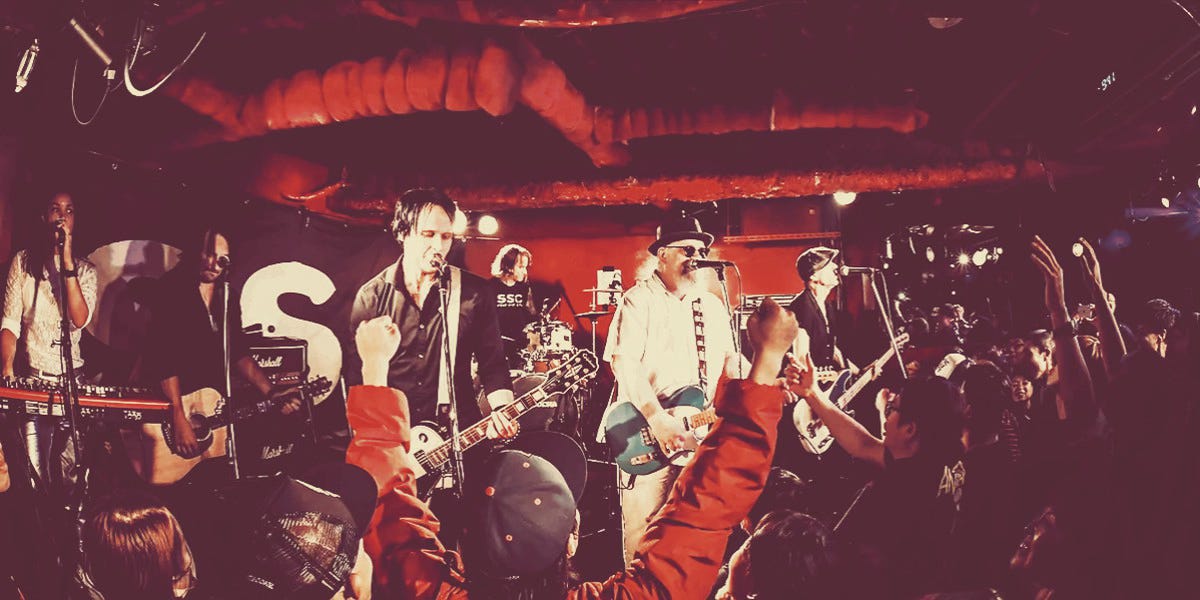
He proved that a person could be several things at once. Both a rock star and a scientist, both young and grown-up. In the early nineties he ran a record label, discovered The Cardigans, and wrote the legendary contract granting him one krona per record sold. He was later doing a postdoc in San Diego while also touring Japan, singing his irresistibly catchy songs with the surf pop band Sonic Surf City.
Ola playing live on national TV in 1993, I was 10 when I saw it, and it made a huge impression on me.
As a professor of neuroscience he led studies on brain cancer in children. And in the middle of it all he would, week after week, lament our football club IFK Norrköping’s disappointing season, as we hardened fans do, often with little sense of proportion. All of this within the same wonderful, generous and warm human being.
Family and death seem to be my themes this autumn. Tragically, the latter applies here too, as this extraordinary person passed away a week ago after an illness, only sixty years old. This dispatch is for you, Ola. My idol. If you wish to learn how to become like him, you’ll find an interview from 2021 at the end of the letter. I suggest you read it with Sonic Surf City playing in the background.
Also in this issue, as always, three bagatelles: one about doppelgängers, one about what happens after a meteor shower, and the last about the life of a pickpocket.
Welcome away ꩜
To receive new posts and support my work, consider becoming a free or paid subscriber.


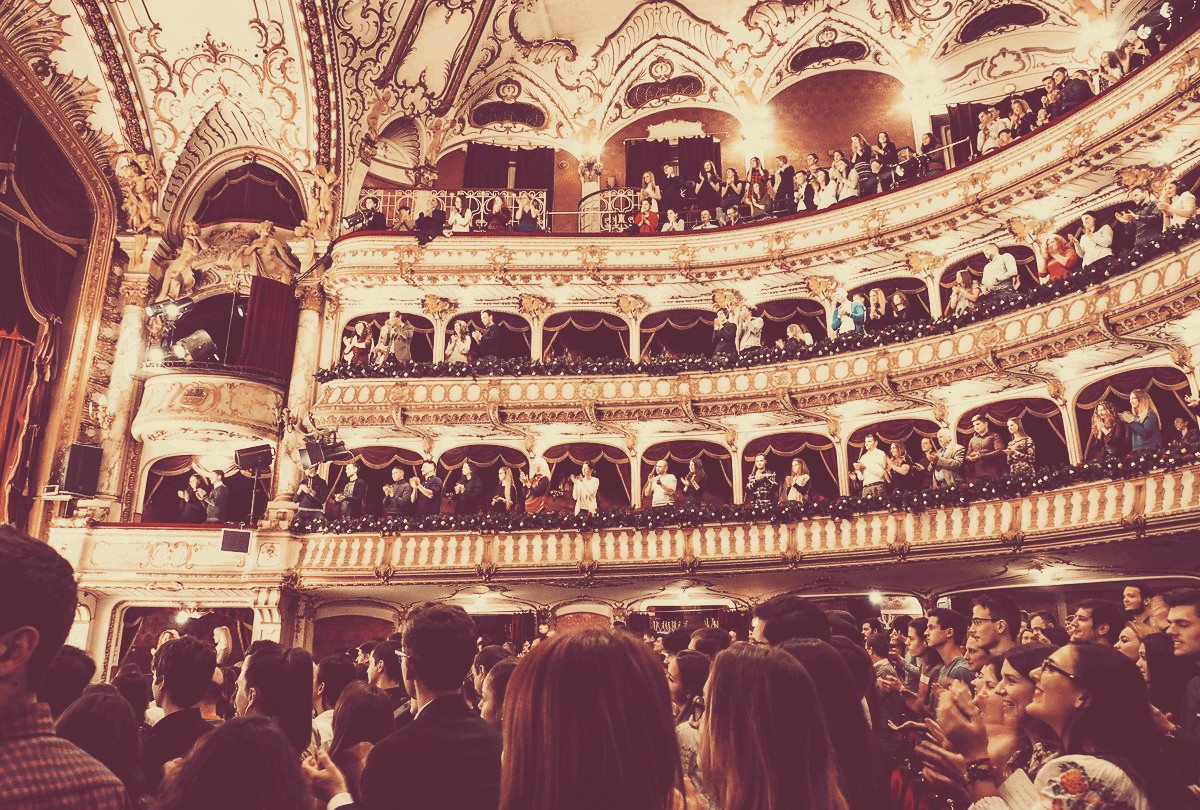
Well? A tiny slit appears between her eyelids, through which she regards you without really seeing you, or at least without acknowledging you. She flicks through the envelopes with deft fingers, a bit like a croupier shuffling a deck of cards. Names rattle past in just that way, and she repeats what she said before: No, the tickets have already been collected. She might as well have added: The person who is you has already been here.
It doesn’t matter what you say now, that you insist anyone in the foyer can vouch for you being the Critic, because she hasn’t got time to ask anyone. Of course it would have helped if you’d brought your driving licence, she points out, because proof is proof, but since you won’t give up she slides you a student ticket. So long as you make room for others in the queue and let her get on with her job of filling the theatre with paying guests.
You end up in the gallery, naturally, and to make matters worse, right at the back beside two pillars and some sixth formers forced to attend by their teacher. They keep scrolling on their phones even after the curtain rises, and as the stage lights come up you can glimpse the audience along the front row. There, eight seats in, sits a bald head resembling your own, wearing a brown corduroy jacket, just like you. When he turns his head towards the aisle you can even see the bright orange frames of his glasses. An ambitious disguise. No wonder the girl at the counter couldn’t tell you apart. The impostor has probably used the tickets many times, while you’ve only gone to keep yourself up to date. In recent years you’ve gone less and less. One could even argue that it’s for the best if someone else occupies the seat. In the grand accounting of the universe, the fraudster restores the balance.
Then the spectacle begins down on stage. It’s a wretched performance in which the actors expose their tools and scaffolding instead of daring to lose control. The script does not help them. The dialogue is a painfully sentimental and introverted mess about a PhD student’s tribulations, with only one interesting line: Academics are often good runners. Lucky for everyone involved that you’re not reviewing this, and poor man who must sit in the front row and, with feigned attentiveness, meet the eyes of those pitiful, talentless buffoons.
During the interval you trip down towards the bar to meet him, no longer angry but rather impressed by the nerve of it, to stand at the counter without hesitation and ask for Joseph C. Rothstein’s ticket, receive it, and spend the entire performance embodying the role of the Critic. Probably the evening’s only sharp performance, you think, since by now you’ve already drifted from the actual chain of events to how you’ll describe it in your column.
Strange, how reality can drift hazily before you for so long without your noticing it, and then it’s as if an inner bell rings, the signal for story, and the sequence gains contour. You could almost have paid to be deceived like this, to become, so to speak, a talking point, a person worth imitating (you didn’t think you were that well known until now). Soon friends and strangers will ask about your daring double, and you’ll say you were impressed, laugh briefly, not ironically but sincerely, as if to suggest there’s something here for all those conservative normies with Revolutionary Road tendencies to learn. You can already hear yourself saying and doing it as you think about how you’ll react. These things happen at the speed of lightning.
He’s standing with a glass of sparkling wine in the gold room, not the least bit ashamed. Probably thinking the safest way not to get caught is to stand in plain sight. There’s some saying about that, about how a lie should be either well hidden or not hidden at all, and here he is. You buy a glass of fizz yourself, stride up to him and say: Cin-cin. He looks at you in astonishment, of course, studies you from head to toe and back again, and when he meets your gaze he asks: Is this some kind of joke? You reply: I was just about to ask the same. He says, without a hint of a smile: Not only must I endure this drivel, I also have the beginnings of a migraine, and on top of it all some clown has dressed up as me. Then a woman joins him. Brunette, salon-polished and at least three decades younger than the bald man. She startles at the sight of you, hesitates over whom to offer the olives, then chooses him and mutters quietly, but you hear her: Creepy, should I call security? He shakes his head, waves one hand as if brushing off a street vendor. No, we’re done here.
And you are. He returns to his seat for the second act, and you leave the theatre. Probably for the best, you think, slightly shaken, as you walk along the chilly Arsenalsgatan. It seems to have rained in the meantime, puddles are scattered everywhere. Better if he writes the piece, you think then, probably to ward off the gloom. Seen from his perspective, the story turned out even more absurd. And in the grand accounting of the universe, it’s probably for the best.
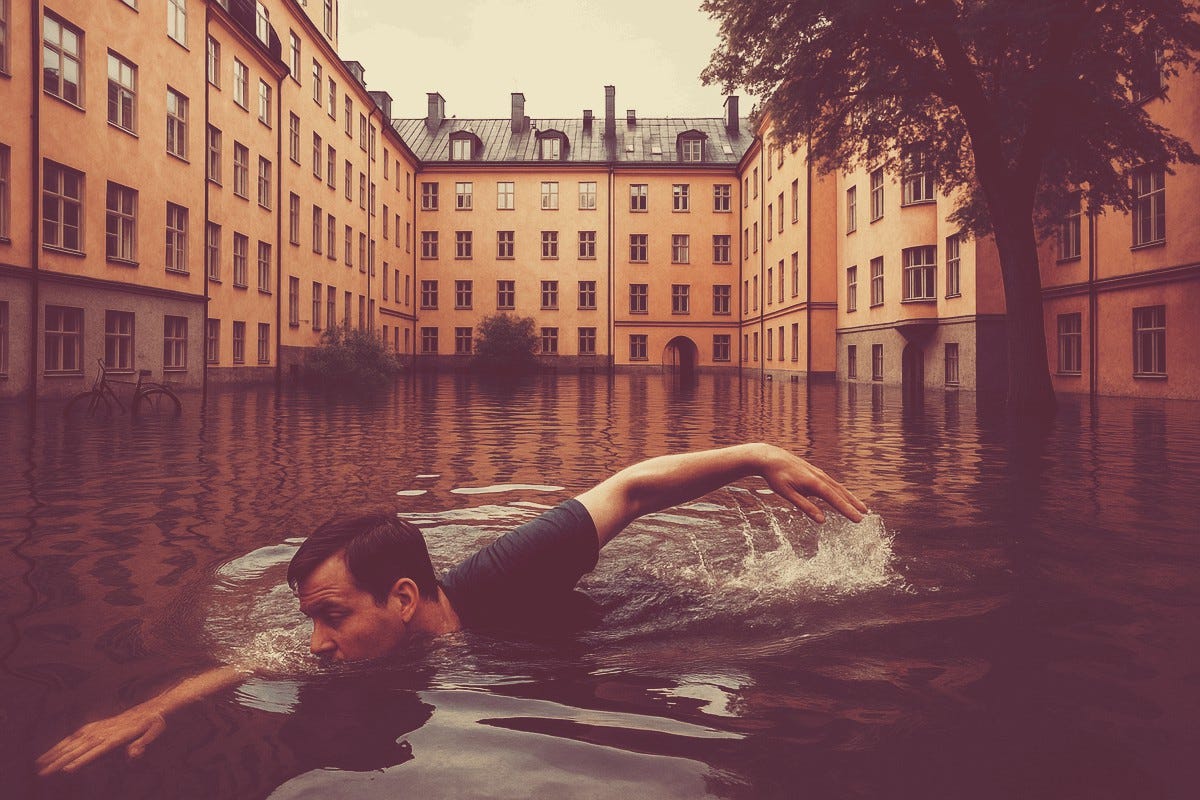
The meteor shower had turned all asphalt into water, a metamorphosis the chemists found entirely reasonable, though it carried serious implications for life in the city. The countryside was more or less spared, but where I lived no one could cross a street without some kind of floating device. On the black market, gondolas soon fetched spectacular prices, and nearly every Stockholm resident tried, of course, to lash together rafts of empty milk cartons, plastic bottles and bits of timber, since we now all lived in an archipelago landscape, each block its own island.
I had always cheated at swimming lessons, and later in life I avoided all water-related activities for fear that someone would discover I couldn’t actually swim. It may sound odd, but I saw the risk of drowning, which would happen immediately if I fell in, as a better fate than being hauled up by some sturdy man with a swimming badge.
These new circumstances did not, however, frighten me as much as I had expected, since, pardon the expression, we were all in the same boat to some extent. Soon ferries replaced buses, and that way, after only a few days, I could reach my workplace where, of course, we discussed the new state of things, though only for the first three or four days, after which the waterways became the new normal.
At night I sometimes practised swimming strokes in secret in the courtyard, in a shallow spot between the bicycle racks and the oak tree, and after a few weeks I could actually keep myself afloat for more than a minute. There is something strengthening about this situation, I said later at the coffee table, and my colleagues were surprised by my sudden optimism, I who otherwise belonged to the habitually bitter, the ones muttering about “no resources”. What do you mean? asked our deputy director. I said: No matter how much water flows in, all we can do is swim, that’s all. As long as we stay on the surface, nothing else matters.
Everyone nodded approvingly, as if I had just read aloud from a fable.
“I’m getting too old for this,” he said after work. “I used to think of it as a game, an art form even, but now it’s beginning to feel like theft.” He drained the last mouthfuls of beer until only the foam clung to the bottom of the bottle. On the table he laid out the day’s haul in neat columns: coins and notes, credit cards, mobile phones, and finally jewellery and gemstones. Bags, family photos and wallets had already been sorted aside, kept only in case of Gucci or Louis Vuitton, though most of what turned up in these neighbourhoods were fakes. “We’ve made a few weeks’ worth of honest full-time work today,” he said after a quick calculation. He handed me a thousand-kronor note, which I gratefully pocketed.
This was during the happy days of the nineties. Our collaboration had begun one morning a year or so earlier when I was, as usual, sitting at the corner café with my motorcycle helmet visibly resting on the seat beside me and a book on Sufism turned outward on the table. A trick for the shy, I thought. One of those neat university students who frequented the other tables might react to either one or the other, preferably the combination: depth and freedom. It never happened. Instead, the old men sat down next to me and began talking loudly, preparing for what I assumed was their day’s work. I had seen them there many times. They must have seen me at least as often. What was new was that I was addressed. The man in the cap, a sinewy type with a quick tongue, stared at me and waved his hand in the air to catch my attention. When I looked up, he asked: “You, biker boy, what are you doing this afternoon?” They were a man short. The fourth in their group, known as Junior, was in custody for arguing with a store detective, which he had informed the others of only when, far too late, he got hold of a phone. “Why?” I asked. “Thought you might want to earn a bit of money,” he said, pulled his chair closer to my table and added, in a lower voice: “Nothing difficult. A trained monkey could do it, but would probably stand out too much. So it’d be better if you joined in. You’ve shaved and all that.” I nodded, pretending to understand, and muttered: “Right, what do I have to do then?”
He was right that it wasn’t one of the harder jobs, and that I was the kind of man who needed easy money. I hadn’t had proper work in years. I kept up my film script mostly to be able to say it was my job, though in truth I alternated between shifts at the video shop and unemployment benefits, and frankly I preferred the benefits. On the way to the underground he gave a monologue about how bank cards were ruining everything, that the whole art form would die with him. Then came his stories: one bloke who pretended to be deaf whenever he was caught, another who could fake a heart attack, and a third who could swing his left arm all the way round a victim’s body while his right pointed towards some poster. He himself needed no gimmicks. He never got caught because his method was foolproof.
My task was to stand at Slussen underground station and hold the train doors open long enough for a crowd to gather at Medborgarplatsen. A minute was enough, but it was a minute that demanded nerve and comic timing. At the last moment I was to stumble onto the train, deliberately get stuck between the doors and collapse as if dead. Then all I had to do was wait for the driver to stop and the guards to come rushing in to sort things out, while my colleague, on the increasingly crowded platform a kilometre and a half away, could go about his craft: emptying back pockets of wallets, liberating women from earrings and rings depending on the situation, sometimes even snatching bags and briefcases, though only when the commotion was big enough. “Cash is king,” he said, meaning that banknotes always came first, as they left no trace and could easily be moved and exchanged.
In his youth he had been inspired by B-movies where prostitutes stole their clients’ wallets, their fingers appearing as if from nowhere. The craft within the craft he learned from an older gentleman outside the opera one evening when he had a side job selling popcorn. The old man’s hourly rate was considerably more impressive, as he could pinch anything simply by snapping his fingers with the other hand. It was hard not to be impressed by the softness and nonchalance the veteran displayed, and later taught. Back then my mentor never drank, not to dull his edge, but he had lost a bit towards the end, as he put it. That was when I came in, at the end.
So I did my best at Slussen that day. Stumbled between the doors and flailed around like a dying fish. What I hadn’t counted on was that bloody bodybuilder who came to my rescue. He simply lifted me into the carriage as if I were a broom that had fallen to the floor. A mild cheer in the carriage when I was “saved,” and then I had to act grateful too. It all went far too quickly, barely any delay at all. My partner only managed two or three wallets, and it was sheer luck that a boa-draped lady with a pearl necklace happened to be on the platform at the time. “What the hell could she have been doing there?” he exclaimed after work as he pried out her jewellery. Then he said: “Tourist, probably. But seriously. You put me in danger. That wasn’t good. In a similar situation Junior would have blurted out that he had a pacemaker or something and that he needed to lie still. You have to think. About safety. What do you think my kids would say if I ended up in prison? Ever thought about that?” “You have kids?”
He had both wife and children, apparently. The first was aware of how her holidays to Mallorca were financed, the latter naturally not. Not that there was anything wrong with the job, he emphasised, not at all, only that it wasn’t properly accepted as a profession yet, out there in society. The norms were shifting, but slowly. He saw himself as an artist, not far below a magician in rank. “But you know, we’ll all be gone soon. The day men switch to plastic cards I’ll have to find something else to do.” I laughed a little, because it felt customary to do so when your boss half-joked like that. I did feel a little hollow about my part in it all, but I tried to explain it to myself by thinking I had done nothing worse than delay a train for a minute, costing society a touch of efficiency and making someone a few seconds late to a meeting. I could live with that. The actual theft, so to speak, was his business. I never saw it.
We kept it up for a few more days, which turned into weeks, months, and a few seasons, and I never thought it would become a habit. It was just so nice finally to walk around with a plump wallet, open it at the bar and ask the girls: “Anything special you’d like? My treat.” It made a difference, it really did, I felt it in the flesh. I didn’t even need the motorcycle helmet anymore, so no one would know I didn’t even own a bike. It didn’t matter that I actually knew my Sufism. Guilt, sure, but life quality was worth more. There might not be a future in the trade, but who needed one with such a rich present? It wasn’t until that job by Sergels torg during the Christmas rush that something broke in me, and in him. As I’d grown more seasoned, the level of difficulty had risen too. Sometimes I had to distract a police officer with a plausible story about a missing poodle, other times offer to carry luggage for families so they’d forget their back pockets, while my colleague relieved them with his well-practised pincer grip, a graceful manoeuvre on a par with a somersault. He had no interest in the plastic cards, which he usually tore up and threw in the bin. Perhaps that was something for a younger generation, but that was another sport entirely, no finesse in jotting down numbers and draining accounts.
That afternoon we’d unfortunately come across a new kind of find. Naturally, when you empty people’s bags, you can end up with anything from tampons to disposable razors, lucky chestnuts or tissues. Every woman seemed to carry a year’s supply in her handbag, in case she needed to blow her nose dry, or what did I know about such things. But this time there was a letter without an addressee. No stamp either. Just an envelope, which I slit open and began to read, at first with a cheerful, roguish mood, like a teenager showing off to his mates. Soon I stopped reading and he asked: “Well then? What happened then?” I said: “I can’t read any more. It doesn’t feel right.” He was genuinely curious now and asked, far too excitedly, as if it were still a joke to him: “So, if I understand it right, he wrote a letter to a dead person? And he knew it was too late, but wrote it anyway?” I nodded slightly, and he said: “And he wrote that he now understood she’d been the love of his life and his best friend, but that he never did anything about it while she was alive?” “That’s how I understand it. Maybe a therapy thing.” “Bloody tragic,” he said and gulped down what remained of his beer. I asked him outright: “You mean it’s tragic to carry around that letter without being able to send it to anyone? Just having it. Day after day. Like an amulet. Is that what you mean?” He slammed the bottle down on the table and almost shouted for everyone around to hear: “All of it’s tragic. The letter. Us. The poor bastard who now knows someone’s reading his pathetic, belated lines and laughing themselves to death.” And that was when he started lamenting that it was all beginning to feel like theft, before he handed me another thousand-kronor note to keep me quiet, I assumed, which I gratefully accepted, because a thousand was a thousand.
We never met again. I stopped going to the café in the mornings, and I don’t know if he kept going, but I doubt it. It was as if the illusion broke for both of us that afternoon. Not because of the letter, but because of his questioning of everything we’d been doing. It was almost like theft, he claimed. And I was no thief. Far from it.

Interview published in the Swedish edition of The Bagatelles in November 2021.
What advice would you give to young creatives and researchers?
1️⃣ The first is originality. The project doesn’t have to be entirely unique, but it should contain something that means if you don’t do it, it won’t get done. The second is enthusiasm. If you don’t feel genuine enthusiasm and dedication for your project, whatever the field, you’ll sooner or later lose interest. You have to burn for it. It might seem obvious at first, but remember the old cliché that creativity is two per cent inspiration and ninety-eight per cent perspiration. It’s usually true. The third is talent. A project can be both original and stimulating, but follow what you’re good at. Of course you can and should try to break new ground, but you do that by building on the knowledge, experience and talent you’ve actually acquired.What has been your greatest cultural experience?
2️⃣ That’s a hard one. I’ll choose two, from my different fields. In terms of music, it would be The Cramps’ concert at KB in Malmö in 1986. It was a real lesson in how to use a single chord and still create exciting music with incredible stage presence. Like suddenly finding yourself in a John Waters film. In terms of research, it would be neuroscientist Larry Swanson, who once managed, in a forty-five-minute evening lecture over a beer, to explain how the brain works. Granted, the lecture required a bit of prior knowledge, but it was an utterly magical night. I usually joke that Larry Swanson taught me how the brain works, and Iggy Pop how we work without one.What trick do you use when you need to be more creative?
3️⃣ The simplest is a couple of beers in a dark pub with good Wi-Fi and my laptop open. It calms me down. I can express myself better and then start browsing PubMed, or Google if you prefer, skim through a pile of scientific papers and begin to spot new connections. Low-alcohol beer and a hotel room work well too, but home or the office don’t work at all. For making new songs it’s really the same thing: listen to lots of music, discover connections, and get ideas. There are many differences between the creative process in research and in music, but this is one thing they share.
Thank you for reading.
– Jörgen Löwenfeldt ✦ jorgenlowenfeldt.se
This dispatch went out to 1,142 readers across 68 countries. If it resonated with you, consider sharing it with a friend who might feel the same, leaving a comment, or recommending it on your own Substack.
A warm thank you to the 12 sponsors of The Bagatelles. Your belief in my work keeps me going, and as a paid subscriber you have access to all content, including my literary diary, the novel Zenopolis and all chapters of Naïveté Travels.
To receive new posts and support my work, consider becoming a free or paid subscriber.
Maybe you'd appreciate this:
✦✧ Looking for the archive? You can find every post here.
In the autumn of 2007, naturally, none of what would later happen had yet happened. I was an intern on the culture desk at Norrköpings Tidningar, commuting weekly to the…