Bagatelle 5 min
Obituary
I was assigned to write the text because I was considered the one among us who could handle the craft, a matter of linguistic talent, an ability to round off sentences, begin them…

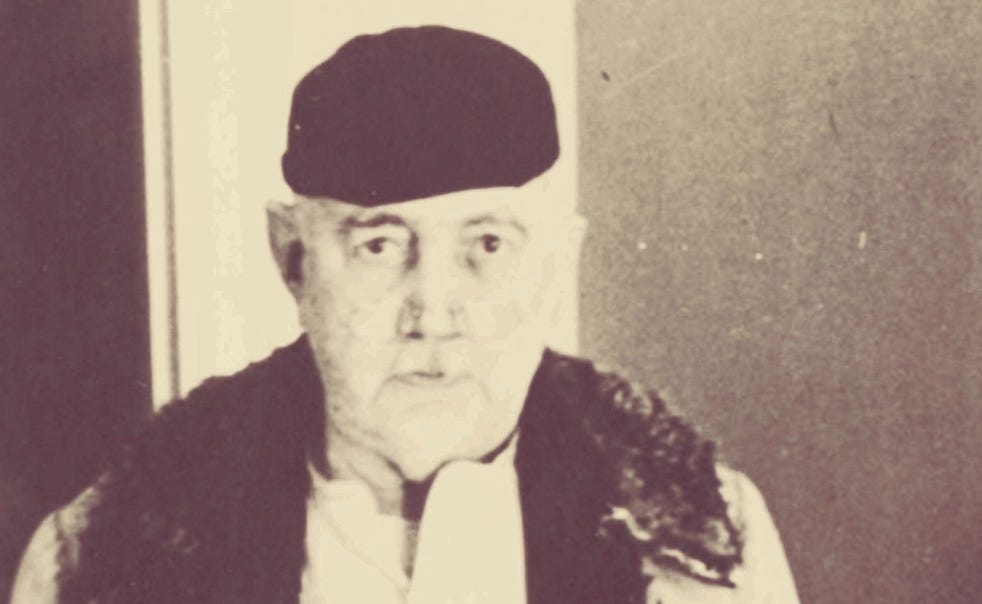
At St Lars Psychiatric Hospital in Lund, between 1909 and 1944, a baron named Eric Hermelin sat and translated Persian poetry. He had lived a drifting life, in service of everyone and no one, least of all himself. One army after another discharged him, once he had drunk, stolen, and proven himself unfit. The younger Eric needed alcohol as a balm, for he was dangerously fragile. Once, he was deeply wounded by his father’s joking remark about his hairstyle, a comment that led the son to flee the country. And so it began.
He drifted between the jails and bars of continents like a fern spore in the wind, in search of something or in flight from something else. From the outside, it was more of the same. From the inside, he was waiting for the signal.
The first half of his life he was an ego, a self. The second half he was a we, a whole. From the psychiatric hospital, he dedicated himself to that whole, which he had, in his flight, managed to absorb through the Sufis and the Persian language.
In a mantra lasting decades, he translated ten thousand poems. Through a cleansing of the soul, he transposed line after line into his mother tongue. For himself alone, and therefore for everyone. The baron found his way home by finding his way out. A logic logical to the initiated, like an unsolvable cipher to everyone else.
I, who am still a self, enter the story exactly 103 years after the work began. That is when I come across Eric Hermelin’s Persian Anthology at a clearance sale. Everything half price, announces the sign in the window. A sudden urge to possess arises. The antiquarian praises my choice and tries, with his eyes, to form a picture of how I came to it. Without success, or so I interpret it.
At home I begin leafing through sentences about “humiliation as opportunity” and “emptiness as gift”, and at that moment I remember my first encounter with the baron, a few years earlier, in what I took to be another life. No, how could the antiquarian have guessed any of this?
She and I were both doing something for the first time. At the city library we scanned the shelves for Persian poetry in Swedish, so she could show me something that was hers. She spun, smiling, in the summer light of the rotunda while I took pictures to preserve the moment.
Upon returning home, she would face floods, a pandemic and uprisings. Years of duty, exploration, humiliation and joy. Of this we knew nothing: here was our parenthesis, in which anything could still happen. She wrote poems to me in her language. I wrote poems to her in mine. Within our perhaps lay an eternity. Only for a brief period, we know now, but is a life even measured in time?
In the years that followed, we kept in touch. Sometimes we spoke daily, sometimes months would pass. How are you, I ask, when videos from Tehran appear in the news, with the woman on the car roof twirling her hijab like a sling in her hand. The internet is shut down, she replies. But I’m doing well.
And I think of Eric Hermelin. Everything simply continues, even memory, which rearranges itself to fit what happens next. What happens needs to happen, so that what happens after can happen, we might say, if we choose to trust the Sufis. Eric needed all his wandering in order to be still. I need the absence in order to register the presence.
On a Sunday morning I think of all this, sitting on the edge of the bed, Persian Anthology open beside me with its many underlined pages, and the memories of the poet suddenly close as yesterday, while the background logic begins to trawl silently through years of drifting.
I was assigned to write the text because I was considered the one among us who could handle the craft, a matter of linguistic talent, an ability to round off sentences, begin them…
Nothing much really happened that summer, and that’s precisely why the following could occur. First, a circumstance: money. The reduced student grant offered in exchange for taking…
I’m standing in the shower thinking about Ingemar. It’s been a while since I thought about him. I used to think about him all the time. He was an echo of reality in the unreal. He…