
Essay 34 min · Password required
The Art of the Diarist
When you do things in public, things happen that you could never have expected. You might say that surprises are, in principle, the only thing to be sure of. One such moment…

And so it happened that I found myself watching an English-Japanese film in Seville while understanding barely half of it. My new friend from Venezuela wanted to go, and I agreed on the condition that it would be dubbed.
Which is how he ended up whispering the Japanese, subtitled in Spanish, into my ear in English. To me, the Swede. The film itself, Rental Family, earned a modest 2+ from me and I have not thought about it once since, but the intimacy of the translation was hard to forget. It felt like being entrusted with a service, administered little by little, over the course of two hours. Whisper by whisper.
The moment brought back a memory of the time I stayed over at my friend C’s place and ended up sleeping in his daughter’s bed (she being at her mother’s). We were slightly tipsy, and I asked whether, in the child’s place, I might be allowed a bedtime story. The question was meant jokingly, and he replied in the same spirit, sitting down beside me in the dark and beginning to tell one. I listened with playful attentiveness to stories of deep forests, restless legs and drawn swords, when, between two moments, I was transported away from the room, the bunk bed and the hard slatted base. The storyteller changed too at that very instant, shifting from body to voice, a voice that replaced my own.
I was there, he was there. Everything was real, beyond jokes and intoxication.
Intimacy does not have to involve eroticism. As these moments suggest, it can arise in the most varied situations, between men and men, friends and strangers. One simply has to notice when one is part of something quite special. This dispatch contains three bagatelles on this theme. A perfumer gives herself away, a stranger overhears a love relationship that is doomed to fail, and an accountant opens up.
Welcome away ꩜
Jörgen Löwenfeldt

It is a day in May when half of the flâneurs are wearing scarves and the other half have rolled up their shirt sleeves. Some of those hungry for summer have gathered on the long bench in the park, where I will become one of them, and she another.
The she in this story is not someone I know, but we are soon to spend an hour together, she with hers, I with hers. At first she thinks it would be better to sit on the shaded side, to create a buffer zone, since she is not alone but has brought along two lively and boisterous boys, but then she decides that the best place is probably a metre or so beside the man reading Marcel Proust’s The Guermantes Way with a pencil in hand, the same person who will write this text in an attempt to understand himself and everyone else.
She has something of a village schoolteacher about her, speaks with a Mediterranean accent, wears a sunhat and sometimes loses her words when she addresses the children. Her manner is nervous, of the kind I am often drawn to and paralysed by, since it forces me into real-time calibration. The children, by contrast, move with complete assurance, running freely past us as we sun ourselves. I have to turn up the volume in my headphones several times just to take in a few lines of the book.
Then he arrives, the man they have apparently been waiting for. It turns out he is the father of one of the boys and the Mediterranean woman’s new boyfriend. Unfortunately my first thought when I see him is not a kind one, namely: can divorced middle-aged women really imagine just anyone, simply to avoid feeling like a divorced woman? Not that the man now sitting close to me is ugly or untalented. He just comes from another planet, and this time it is not merely Mars and Venus but rather Pluto and Mercury.
“Oh, you shouldn’t have waited with the picnic,” he says without meaning it, and this is what I soon understand to be characteristic of his language: an undertone invisible to him in everything he says, but visible to everyone else. He has no village schoolteacher aura, rather that of someone who spends his days in an office, leases his car and can easily slip into casual racism in the sauna. I am being unkind again, sorry, because he does not deserve it, but I want to mark a dissonance, the one everyone notices except the unfortunate couple in love. A sort of non-existent inward attentiveness in both of them, which leads them towards feelings and impulses that hit every target except the one that matters. The elephant-in-the-room-sized one.
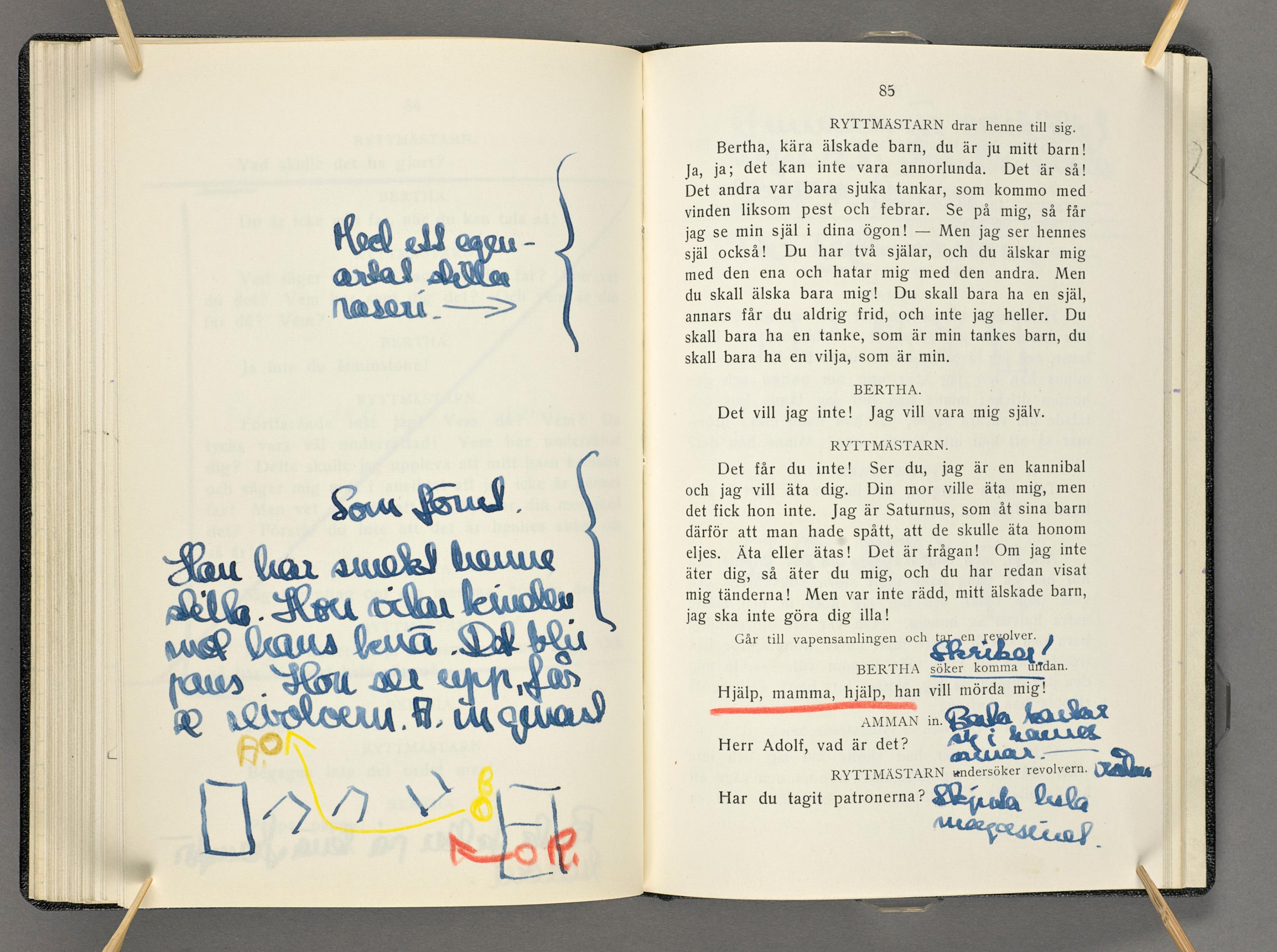
When there is no longer any point even in pretending, to myself, to read the book, I start making notes in the margin instead, because what is happening around me has clear Proustian qualities. He begins to speak, with that tone again, which seems designed solely to impress an audience rather than to address his son, to whom he says: “Now I want you to finish your yoghurt.” He tries to sound gentle, but also firm, letting the emphasis dance on every syllable. A manner he adopts to signal that he is both masculine and a present parent, but beneath it lies that invisible pressure of: why do I have to put up with this? A question he probably does not hear himself and is therefore unaware of.
It is complex, being a man, he surely thinks. In that he is of course right, just as it is evidently difficult to be a divorced woman in search of a decent bloke who has read some book other than Zlatan Ibrahimovic’s. The Pluto man now jokes with the children. He tries to adjust to their simpler vocabulary and references and talks first about high fives and then about the Jackson 5. The latter goes over their heads, but the jokes were never meant for them. The boys finish eating quickly and start running again. It becomes possible for me to continue reading, but then suddenly the mother begins to cry, dramatically and unmistakably extrovert, as if she wants one of us others to intervene, but we of course pretend to be deaf, since we are Swedes.
The Pluto man now knows that he needs to show emotion, but he also understands that he has to handle it neatly because there is an audience. “Think about your breathing,” he says, since he is apparently more focused on effect than cause. “That’s not how one should think,” he says, thereby explaining that in his view she is feeling the wrong way. When that does not help either, he comes out with: “Let me know if there’s anything I can do for you.” The sort of thing people say when they really have no intention of doing anything for the grieving person, but have not entirely ruled it out, since that would mean they were bad people.
None of this seems to reach her. She does not even understand how the crying began, offers explanations such as being stressed by the boys’ dynamic. That they show no gratitude. That she builds up a baseline stress. That she cannot find her role. That the joint trip to Öland was probably a bad idea. He says: “There, there, love.” But what she actually feels, and cannot reach, is this: everything just feels completely wrong all the time and I do not know why. It feels as though I am constantly being forced into a framework alien to my inner nature. As if I can never be seen and appreciated for who I am. As if I always end up being the hysterical one when all the disparate feelings spill over me. And what it really means is this: we do not fit together in any way. My body, my soul, my psyche are asking me to get out, but I cannot understand it.
Instead she says: “I’m hopeless and messy and you make everyone laugh.” He says: “Don’t build a narrative.” She continues, of course, to cry, because nothing is resolved, and he sits beside her helpless, as if he only has a hammer when all that is needed is a Phillips screwdriver.
The boys run lap after lap with a new, wild frenzy. Now it would be impossible even to read the back of a milk carton.
He understands that he should leave, that exit is the only solution. When he has picked up his son, he asks: “How much should I pay for the picnic?” The mother pulls herself together and says: “Two hundred and seventy-three kronor.” The moment he leaves the bench, a calm arises of the kind that comes when a photocopier stops working in an open-plan office. All that remains are our thoughts.
Here there is time to think that it is nevertheless logical that a man with such a different nature should also have a child with the same temperament and rhythm of life. That it simply is what it is. That energies either match or they do not, and so many still try to combine their hammers with screws.
Now the mother is finally still, in both soul and body. Her son too. They hug tightly, symbiotically, speak calmly in their first language. A few more tears fall. Perhaps from relief, perhaps from resignation. She probably still does not understand what is wrong. And perhaps that is how it is, that we always see everyone except ourselves, thinks the man sitting beside them, before he walks home alone.
Contribute $5/month, or $2.50/month with the annual option. Your support helps me keep writing and publishing independently. As a thank you, patrons also get access to all my long-form writing, including complete novels.
Become a paid subscriber ↗After reading a newspaper article about how Neanderthal DNA had been extracted by processing a fossilised finger, I once again began to occupy myself with the idea of travelling through time.
To some extent I was already engaged in this pursuit; a what-if loop had been running through my mind for many turns. A few times I had played along and built futures based on shifting decisions: how I said no instead of yes, yes instead of no, stayed instead of leaving.
It was all merely futile daydreaming, I knew that well enough, but at least of an advanced kind. I did not settle for replaying the choices themselves; I painted entire future scenarios from them, years and decades of decisions branching out from the new node.
These were fantasies, however, not time travel. Still, I could not shake the thought of being allowed to start again. As I strolled past the perfumery in Gamla stan and saw their tourist-facing sign about encapsulating memories, I took them at their word, stepped inside the shop and told them about my destination:
I want to go to the day before, when I vacuumed soil and clay pebbles on the balcony. A mild surrealism over the moment. The wind brushed my face. The air was clear and cold. The feeling that everything was still there.
There was something refined about her, my scent creator, as if through all her senses she had progressed to finding yet another one, unreachable to the rest of us. She took my request seriously, because this was precisely how the industry always worked, starting from a feeling that needed to be circled in. Whether it was spring sunlight, Ariana Grande or sin.
You need to give me a little more, she said, in an unexpectedly light and velvety voice that made me think of mango. I do not know why I made that association; it must have come from the mood of the situation itself.
I told her:
The olive tree had just put out new buds after a winter indoors. The geranium was past flowering. The clockvine had nearly wandered up towards the balcony above. The sun lay at an angle between the courtyard buildings and created a slit of light over me, so I had to squint. My palate was marked by Ethiopian coffee with an aftertaste of strawberry Cornetto. My thoughts were marinated overnight by a dream in which I was hyperpolyglot and all languages were therefore comprehensible, but only during the night.
She took no notes, which made me anxious, much as when a waiter memorises an excessively long order. To prove something, but to whom?
I went on talking:
So this was the day before I said no. But perhaps that is beside the point.
Not at all, she said, because you did not know that then. If you want to cause a correct temporal displacement you need to be completely truthful to the actual event. How full was the vacuum cleaner bag, by the way? I assume it was an Electrolux?
I had really wandered into the shop almost as a joke, but now a seriousness settled over the situation and I began to feel a hope growing in my chest. I gave her further instructions.
At last she was satisfied enough to proceed, so she led me a few metres behind the counter into the lab. Before my eyes a process began with bowls and tubes, as she threw out various names of fragrance materials pulled from refrigerators: cis-3-hexenol, myrcene, lavender EO, and a little sabine since the balcony mat was plastic.
More questions followed as the potion was being assembled: from which direction had the wind come? Had I watered the plants recently? Were there any cigarette butts nearby?
The glass rod spun in the tube. She sniffed a little and muttered to herself:
All the notes have to land exactly. But a little more lactonic, yes, wouldn’t you say. Yes, wouldn’t you.
A brief artistic pause before she said, with restrained triumph:
And there we have our accord.
The liquids in the tube tumbled together into a single entity. She let it all run down into a glass cube, screwed on the lid, affixed a label on which she wrote 4 June-15, then sprayed the scent over her neck with a precise press, moved her hair aside, closed her eyes and whispered to me:
Bon voyage.
We are old friends now, I realise as I sit down across from him at the café. We’ve met regularly for seven years, yet only seen each other seven times, every spring in connection with the tax return, when he goes through the accounts and helps me with deductions. It’s more of a sideline these days, since with each declaration we discover something new to brush into view about one another, and he says, have you considered that even kindness can be a form of performance?
In fact, he works with addicts, alcoholics, drug users, people on the edge of the absolute edge, and his support can sometimes provide just enough balance to tip them into safety. Only one person has ever thanked him for that extra weight, so the affirmation he hoped for came sparingly. Being good is watertight, he says, but still the same as everything else. He needs somewhere to rest his heart after the working day, runs an accountancy firm, goes through my purchases and invoices from the previous calendar year and thinks I’m bordering on too meticulous, and he says, I get a little better with women each time I try.
Two tax returns ago I had separated from the mother of my children. Last year, it was his turn. This year, we’ve both started meditating, have calibrated inwards, added a few more decimals, been on retreat. I’ve burned out and found a method of focusing on the left side of the body that short-circuits the brain, and he says: It’s around your age people start running out of strength, and then they can choose to change or to keep going, and not many who keep going make it to my age.
Once he worked nights at the church, but the priests were neurotic and the council spiritually impoverished, Christ’s message remote. I show him my text about the church caretaker who discovers hidden, possibly inner, rooms, and he tells me about his new novel or non-fiction book about notorious winners, who follow systems to the point of absurdity, who know they’ll lose thousands every week for a year, right up until they win. I say, happiness isn’t something you become, it’s something you are.
The declaration is dealt with in under a minute, because I’ve already submitted it and filled everything in correctly, since I know how to do this now and we both know that.
These aren’t difficult matters, but they are a reason.
Thank you for reading.
– Jörgen Löwenfeldt ✦ jorgenlowenfeldt.se
This dispatch went out to 1,642 readers across 83 countries. If it resonated with you, consider sharing it with a friend who might feel the same, leaving a comment, or recommending it on your own Substack.
A warm thank you to the 21 sponsors of The Bagatelles. Your belief in my work keeps me going, and as a paid subscriber you have access to all long-form content, including the novel Zenopolis, all chapters of Naïveté Travels, and my work in progress: Bardo Noir.
To receive new posts and support my work, consider becoming a free or paid subscriber.
Maybe you would appreciate this:
✦✧ Looking for the archive? You can find every post here.
When you do things in public, things happen that you could never have expected. You might say that surprises are, in principle, the only thing to be sure of. One such moment…
For several years now I have been reading In Search of Lost Time together with an older woman. Or, I think I have. I do not actually know her age, or her gender, but I can still…