
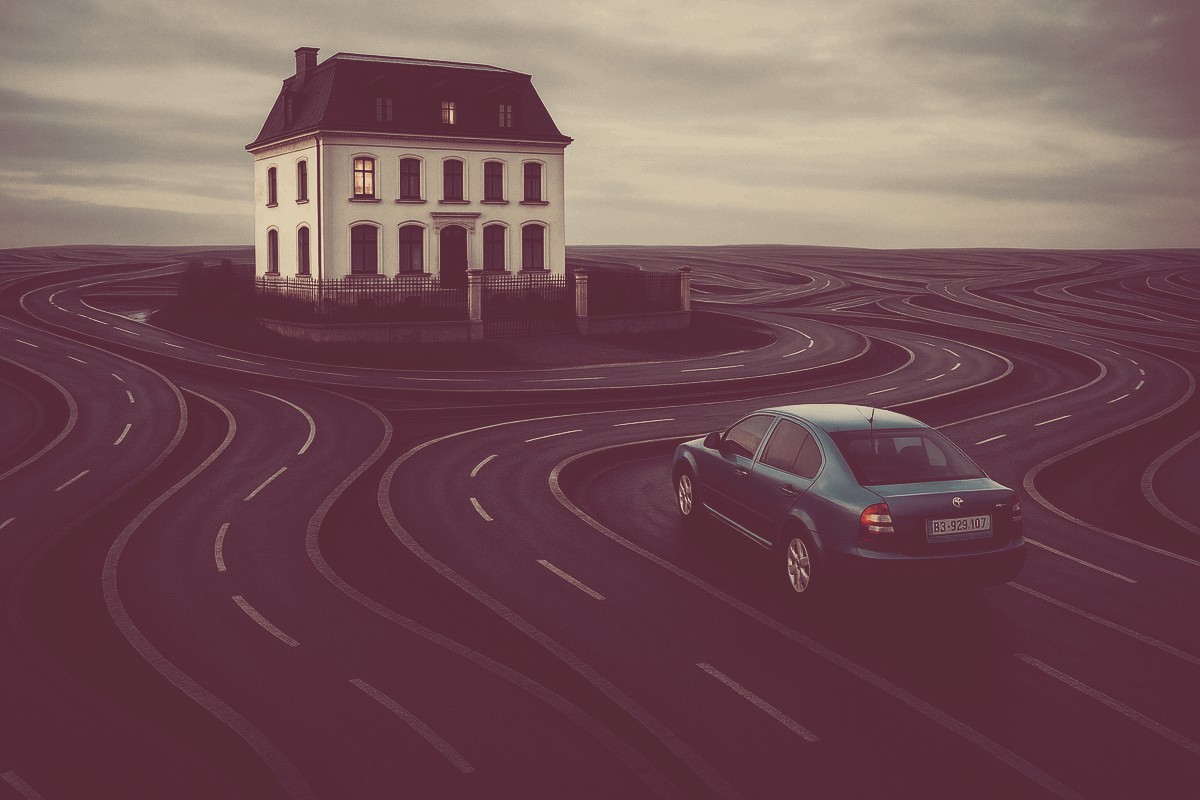
Naïveté Travels
In the autumn of 2004, I was in Belgrade with my then-girlfriend. Late one Friday, we stumbled upon Ryanair tickets for one krona and went for it. We strolled, after a long day of shopping, around the Jewish quarter and passed a seedy establishment lit by flickering fluorescent lights. Stern-faced men drank mint vodka along the bar. The place reeked like a sewer leak. “A so-called Jan Berger establishment,” I said.
At the bar, a golden-haired man flinched, none other than the very entrepreneurial legend I had just mentioned. He met my gaze and, in fluent Swedish, invited us to join him. I hadn’t even known he was still alive.
He hardly needed any further introduction, the frontman of the Swedish IT miracle of the late '90s. The scruffy visionary was a media darling, politicians’ favourite, and had even come second on Ica-kuriren’s list of Sweden’s most admired men, just behind the King. But over the course of a single day, when the pendulum of the stock market swung back, he lost his company, his girlfriend, and his home. No one really noticed when he disappeared from the spotlight, after all, so did all the other figureheads, while small investors desperately tried to safeguard their hard-earned savings. That’s how those times were. Easy come, easy go.
I was among those who kept thinking about him, because I missed his presence in the public sphere. He served as a counterweight to what scared me about the business world. CEO Jan Berger was infamous for holding press conferences in a dirty hoodie at McDonald’s and announcing upcoming multinational deals while slurping a milkshake. At other times, he might decide to hire a dozen strangers off the street to diversify the company culture, when it became, in his words, too corporate. Some staff were well-paid, obnoxious teenage kids whose sole task was to question everything (including the need for meetings, business cards, and annual reports). But it worked; it was as if everything he touched turned to gold. A Midas of the new economy. Until, that is, the magic touch suddenly vanished, when the zeitgeist shifted.
Jan Berger no longer looked like himself, more like a caricature, with hair sticking out in all directions like from static electricity, stubble about a week too old for scruff. His eyes were cloudy, like his drinking companions’ at the bar, but then a flash went through them. He waved us over to a table by the wall and, with a rehearsed finger flick, signaled to the bartender to bring another bottle. Our little glasses were filled to the brim with liquor.
“There’s no better beginning than a terrible ending,” he said, downing the contents. “I’ve had to reassess everything. I need to restore my honor.”
He went on and on. It was clear he needed someone. That it turned out to be me and my girlfriend was the coincidence he had been waiting for. Not only had he found someone who spoke Swedish after his years in exile, but also someone who not only recognised him but uttered his name with a hint of admiration. I was only six years younger, no more, but at our ages, that meant the difference between doing and observing.
He sat up a bit straighter as he orated, as if we were helping him find himself. I knew the whole time that we were side characters. We were there to listen, not to expect any questions in return. Whatever his current greatness was about, perhaps drinking a bottle of liquor on his own without trembling. Apparently, he was so far into alcoholism that it no longer affected him, he had lapped the addiction.
My girlfriend initially found the situation amusing, as it could make for one of those fun travel anecdotes to share with coworkers upon returning home. You’ll never guess what happened! And who we met! But when Jan Berger extended his monologue about being abandoned by a gold-digger, just because he had promised options that turned worthless, and about high heels through glass tables, she started squirming, feeling she had enough for an anecdote at least, and that we ought to head back to the hotel. It had been a long day, after all, and lugging around the shopping bags was tedious. Jan Berger noticed the retreat, fished a ballpoint pen from his trouser pocket, and scribbled something on the back of a beer coaster, which he flipped over to my side like a frisbee.
“In case you change your mind,” he simply said, and returned to the bar.
It was a phone number, neatly written with plus sign and country code, to ensure I’d be able to reach him if I later got the idea to call. Only then did it strike me that he had likely recognised me too. Back in the day, I’d been an intern at one of those free financial newspapers that disappeared along with the new companies. When everything returned to normal and consensus-Sweden agreed that online business was a chimera and money in the bank was the only reality. Maybe he wanted to give me a story, and I could really use one, having spent the post-university years writing press releases at the Environmental Protection Agency. Important, I told myself, but the truth was I’d barely visited the forest, and my dreams lay elsewhere.
“You’re not actually going to call him, are you?” my girlfriend asked as we walked away toward the safer tourist quarters. “He looked like he lives in there. Just stay away.”
“But that was Jan Berger. The Jan Berger. Don’t you get that this could be my break?”
“Honestly, I barely remember him,” she said. “And it doesn’t matter who he was. Now he’s just a bum."
“That’s the whole point,” I said.
“Just leave it, that’s all I’m saying.”
“Okay, okay,” I said. “Maybe you’re right.”
It took her an unexpectedly long time to settle down that evening. She was high on impressions and wanted to sort out the Easter plans from the hotel bed, even though it was six months away, and she fretted that she’d already used up half her vacation days, but then again, she wasn’t sure she saw a future at the agency. I half-listened. I probably agreed to celebrate with her parents just to get the subject out of the way, because she hugged me tight, and only after that did she drift off to sleep.
Now or never. It was two in the morning. Our flight left the next day. I tiptoed into the hotel corridor and dialed the number on my Ericsson. This was going to be wildly expensive, but how much would regret cost, regret for not having acted? Lying on a deathbed thinking about how life could’ve branched off in a more adventurous direction. My heart pounded arrhythmically as I pressed the green call button and waited.
On the other end of the line was a voicemail. A man’s voice with an English private school intonation began explaining the circumstances:
Good day, and welcome to Naïveté Travels. Regrettably, we are unable to attend to your call at present. Should you be an investor, kindly press 5. If you are participating in our beta testing programme, do press 9. Members of the press are courteously requested to terminate the call and refrain from further contact. For all other enquiries: please do leave a message after the tone.
He said the last part as overly politely as the rest. Then he repeated the message in German, French, and what I took to be Japanese. Naivite Toraberuzu e youkoso. Honjitsu wa ainiku odenwa ni deru koto ga dekimasen ... and so on. As far as I could tell, all the languages were spoken fluently, though the same man delivered all the messages. At last, a beep, a vanishing tone that almost apologised for itself. I might easily have missed it if I’d been on the street. Then I left my message, in clumsy English:
I got this number from Mr Berger. I hope I got it right. Can you please ask Mr Berger to call me? I wish you all a good day.
And I read out my mobile number. When I hung up, I was ashamed of how the answering machine man’s tone had affected mine. I could at least have ended with a “cheers” or “bye,” since it was Jan Berger who had given me his number and not the other way around. As it was, it sounded like I was begging for his attention, when really I was in the more favourable position. If he wanted to talk, I was here. If not, it didn’t matter, or so I told myself.
Then I stood with the phone in hand in the lit-up corridor, surrounded by doors. This hadn’t been part of the plan, which only extended as far as calling. The rest was supposed to unfold on its own. I couldn’t go back to bed next to her. I headed for the elevator and let it take me down to the lobby. The night receptionist was reading a textbook on microelectronics and gave me just a nod when I sat down in the lounge area by the palm trees. To pass the time, I leafed through some brochures about the Kalemegdan Fortress and the Tito Museum, and for the first time on the trip, I craved ćevapi. Maybe some places were still open?
The next thing I knew, someone was nudging me. Apparently, I had fallen asleep on the couch. The receptionist muttered something in Serbian and pointed at my mobile. A MIDI version of “Light My Fire” by The Doors echoed through the lobby and probably all the way up the stairwell. I had programmed the tune myself, note by note, and didn’t want to change it, but this wasn’t the time to explain that.
“Sorry, sorry,” I slurred, answering the call just to silence the music.
“Yes, hello?”
A soft click on the other end, like the sound of a tape recorder starting up, followed by a crackle, and then sound. The same voice as the voicemail.
You shall receive the instructions but once. Neznanog Junaka 53. 04:30 hours. Code: B1742. Come alone.
“Can you repeat that?”
The call was already over. All I remembered was Junaka and 53. The receptionist looked up, annoyed, when I asked for help. He gathered the bits I had: including Swedish businessman, Eton English, nighttime meeting. He rolled his eyes, as if I were the tenth person asking the same question. Then he pulled out a tourist map from under the counter, placed his finger on the address, and explained that it was an elegant building in Dedinje, one of Belgrade’s most prestigious areas, home to the president’s residence, embassies, and grand villas surrounded by high walls.
“Can you help me get a taxi?”
He gave me another disappointed look, which said, Can’t you do anything yourself?, but then muttered “of course” out of pure duty and helped me get a car.
“Oh, and if my girlfriend wakes up, just say I was hungry. I’ll be back soon.”
A Škoda Octavia rolled up in front of the entrance. The taxi driver muttered "Palazzo" and smiled at me in the rearview mirror, the way Eastern European men do when they know at least one word in your language and want to use it. It might as well have been “Brolin” or “Volvo.” Only when I was dropped off did I understand that it was the name of the destination. Beyond the gate loomed a mighty building, intimidating even—at least at this hour. The palace was Italian in style, with ornate cherubs on the fence, fountains, and a meticulously manicured garden. I pressed my finger to the intercom and, after a second’s delay, was met by a new voice, a woman’s, who said:
Four. Thirty.
Then she hung up. It was an instruction I’d missed from the lobby couch. In any case, I wasn’t late. Soon a guard sauntered up: a man with a vaguely academic look. He had with him a contract that seemed to concern my agreement to be filmed. I couldn’t see a single camera. Since he didn’t seem to understand English, I eventually scribbled my signature, whereupon the guard wandered back to his booth somewhere inside the courtyard. It wasn’t long before another taxi stopped at the curb and let out a couple of young, well-made-up women. They stood behind me and were followed over the next hour by more. I now assumed we were queuing for an exclusive nightclub. Everything pointed in that direction.
The girls got annoyed when I voiced my theory.
“How can you say that?" said the one with such thick eyeliner that I couldn’t focus on her pupils. “Why are you even here?”
The other, with short red hair, was more composed, as she grasped how little I understood:
“We’re queueing to work, okay? What are you good at? We’re gonna do screen printing, or be extras in a film. We haven’t decided yet.”
“I have a meeting with Jan Berger.”
“Who?”
“Blond, curly-haired guy. About thirty. Swedish. He’s a businessman. Or, he used to be, anyway.”
“Never seen anyone like that in there. And I’d remember someone like that. But Quentin shows up sometimes. And Prince, but only once,” said the composed one, and I could tell she was proud that those internationally known names had visited her hometown.
I tried something else:
“Naïveté Travels?”
Her expression changed. She stared at me like she’d just realised she’d been lecturing physics to a Nobel Prize winner. She lost half her vocabulary at once.
“Really? Oh. Wow. Cool. Well then.”
I recalled an interview with Jan Berger and the others at Clockwork, as their conglomerate was called, with a name nodding to the Kubrick film. They described the headquarters on Birger Jarlsgatan with the same words the girl used for Palazzo: like Andy Warhol’s vision for The Factory. A break from streamlined capitalism, an opening for free creativity in an otherwise relentless system. In the end, the ideas would win, I remembered Jan Berger saying repeatedly, and it took root in me. No focus groups or middle managers were needed, he claimed, rhetorically asking whether Leonardo da Vinci had ever had a business plan? As if it were natural to compare oneself to the greatest genius of all time. News clips from the office showed pinball machines, a soda crane, and people in bean bags deconstructing synthesizers, without any real direction beyond desire. It didn’t matter much in those years. The venture capitalists’ money rained down on them, perhaps precisely because they were incomprehensible. The wilder the idea, the more money for the new economy’s gurus.
After the crash came other articles. They implied it had all been a facade, crafted for PR to blind investors and reporters. In reality, they were like any other company, and the business model—consulting services—couldn’t scale more than a human being could scale, even if that human was a computer expert.
The Factory Belgrade. That was a story. The forgotten legend who started over in the East. Then my nighttime queueing could serve as a stirring scene: just like our random meeting at the bar, the late-night phone call in the hotel corridor, the taxi driver, the girl with the eyeliner. I needed to memorise it all, I realised. Maybe he wanted more than an article? A book? What did he say again? No better beginning than a terrible ending. Could be a title. Or just The Factory. Leave it to the publisher. I rehearsed the sequence. What had he been wearing? How did he smell? What was in the shopping bags?
The guard stepped back onto the palace grounds. It was half past four. The line surely stretched a hundred meters behind me by now, and more people kept arriving, all with eclectic styles, piercings and tattoos, underdressed mixed with overdressed. However they carried themselves, you could tell where they were heading. The guard, the academic, had a clipboard in hand, as if planning to take roll call, and started with me.
“The code,” he said.
“What code?”
“To get into the Palazzo, you need to give your code. You should have received it.”
“Yeah, maybe I did, but unfortunately I don’t remember it. There was so much information. I was asleep.”
“Then there’s unfortunately nothing I can do,” he said emotionlessly and immediately turned to the girls behind me, who smoothly rattled off the digit combination that let them through the gate. When the guard saw I was still standing there, he simply said: “Time to go home.”
Authorities have always made an impression on me, all the more so in those years. I did as I was told, trudged dejectedly to one of the taxis dropping people off, and asked to be taken back. Tired and sore, I leaned back in the seat. The night traffic was sparse, the red lights few, so it was a quick shift of worlds back to the hotel. A different receptionist, the morning shift, I assumed. He seemed a bit more charismatic than the other. I mouthed a good morning and went to the elevator, let it carry me back up, found room 107, turned the key as silently as I could, and slid under the covers where my girlfriend was still sleeping, unaware of my nocturnal escapades. Just my luck, I managed to think before sleep claimed me too.