Essay 34 min · Password required
The Art of the Diarist
When you do things in public, things happen that you could never have expected. You might say that surprises are, in principle, the only thing to be sure of. One such moment…

I was eleven years old the first time I was pulled into storytelling. It happened unexpectedly, during a school assignment, and I found myself writing deep in flow—silly, dreamlike, many layers beyond the borders of realism. I could have gone on forever.
My teacher was not pleased. After scrutinizing the text I had produced, she tried to set me straight. She even scribbled across the pages, as if to underline that I had engaged in something sinful when I was supposed to be useful. It felt like a violation. I knew something was wrong—but I also learned, then and there, to avoid that kind of writing, even though it was clearly where I felt most at home.
But once I started over, many years later, I also learned to stop caring so much about what others thought. Their opinions, of course, should be taken into account. But if my writing belongs to someone else, the whole endeavor loses its purpose.
Which is why I’m delighted to present this issue of The Bagatelles, devoted entirely to stories untethered from reality. We meet an elevator collector, continue to a world record-holder in note-taking, and end with a conflict between rival trail groups.
Nonsense, sure. But meaningful nonsense.
Welcome away,
Jörgen Löwenfeldt


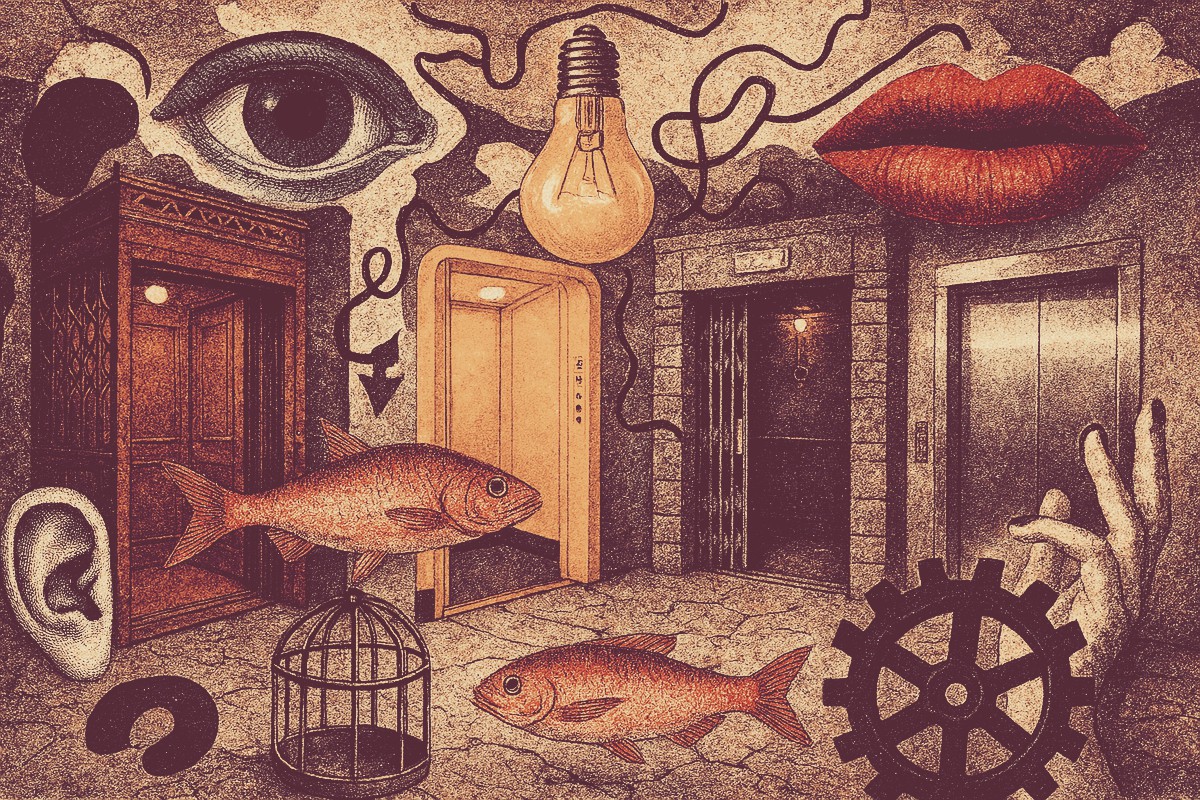
Other diplomats collected exotic artifacts like fans and kimonos. He collected elevators. He stored his finds in the basement, gathered over a lifetime of travel—days spent in conference rooms, negotiating coefficients, evenings spent wandering alone through cities, searching for a new little room to bring back to his villa.
I discovered the collection during a dinner party. I was actually headed to the bathroom but took a wrong turn, suddenly tottering down the stairs into the basement. I quickly realized I must have made a mistake, since the steps descended so far, but by then I wanted to keep going—and down there, at the very bottom, I met the collection. Easily forty or fifty elevators, all sorted by year of manufacture and genre, as far as I could tell.
The colonial-African models caught my attention immediately. One of the more distinguished was a Schindler that had once lived inside an art deco building in Zamalek. Its double doors were delicately carved in an intricate, ominous pattern—something like a promise to be swallowed. Another was a paternoster lift from HSB’s offices on Fleminggatan, with open carriages and original buttons. The safety instructions were engraved in French, and might well still be useful, judging by how rickety the construction seemed.
The entire basement must have been blasted out beneath the house to make room. Half in jest, I stepped into a metal cage from the Central European 1930s group, drew the gate shut, sank into the leather seat, and pressed the button for the second floor. On cue, the elevator groaned and began rising toward the sky. Floor after floor slid by outside until I stopped with a slight jolt at level two. I stood, pulled the gate open, and stepped out.
I landed in a stairwell on Kommendörsgatan, which I hadn’t visited in thirty-three years, so I had to consult long-stored muscle memory before, with the help of nameplates, I understood where I was. Right next to the Montessori preschool was the apartment where I spent my earliest years: Löwenfeldt. I rang the doorbell, but no one answered. I put my hand on the doorknob—it turned, and the lock gave way.
There in the hallway, beside the Persian rug, stood the uncomfortable Malmsten armchair I once managed to crawl under during a game of hide-and-seek. I crouched down, reached in—and to my surprise, felt a warm, supple, moving body. Let go, cried a high-pitched young voice, I’m coming out. Footsteps, muffled, struck the parquet. But I saw no one. Not even the child I had found. A voice—reminiscent of my father’s, but a bit sharper—spoke into the air: Where could he be? Seriously, where could he be? And then the child again: But I’ve been found, I was under the armchair. But there were no bodies, only sound waves.
Before time had the chance to reveal my trespass, I returned to the stairwell and the elevator and pressed the round button for the ground floor. The cage trembled and we fell back. Soon I could step out into my friend’s basement. I half-jogged up the stairs and quickly found the way to the bathroom, without needing to ask. Not hard to find at all—I had simply mistaken the door.
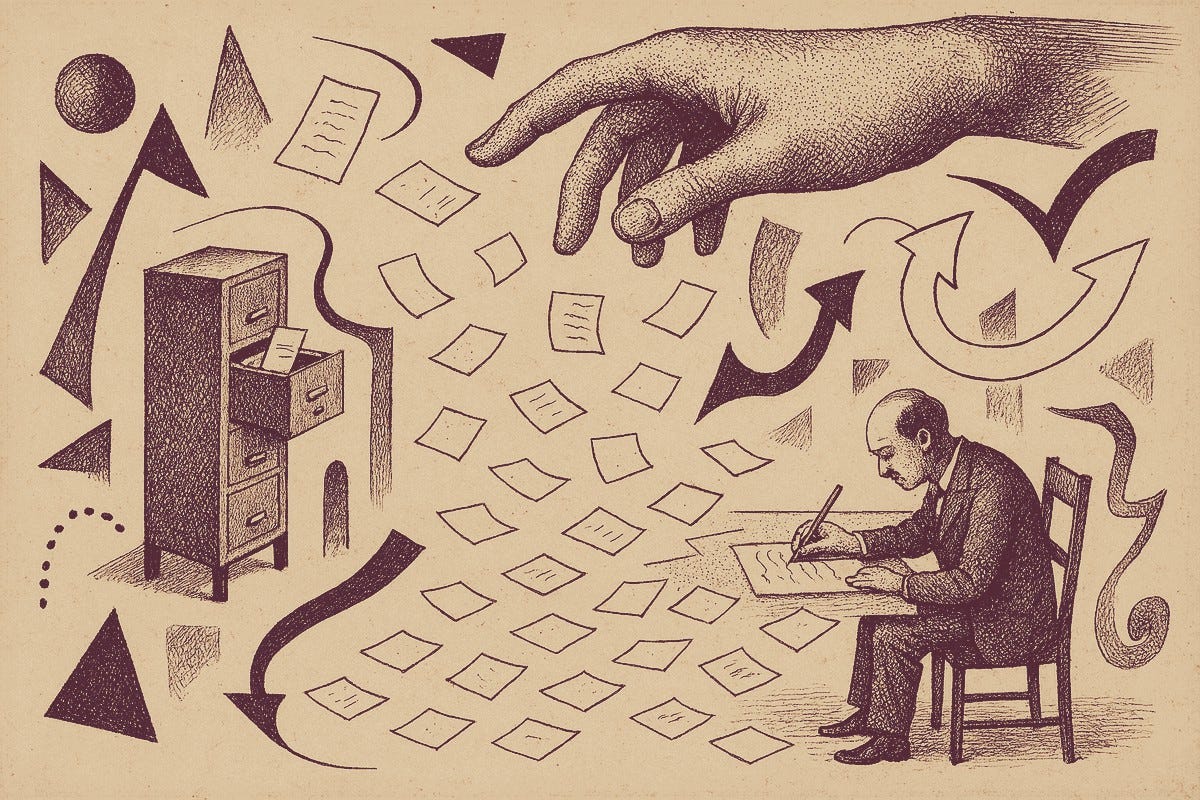
He had set out to transfer everything from the perceived world into the pencil world, and with the help of millions of tiny slips of paper, to document quite literally everything—no exceptions. A monumental project, of course, but earnestly undertaken. The moment a memory surfaced, it would be put to paper and then placed in the correct pocket of the archive hutch, a procedure that naturally was documented as well, and stored in a separate hutch, which he jokingly called the meta-hutch, reserved for all thoughts about the project and its origins.
He devoted every day to his papers and observations, old or new—it made no difference. It could just as well be the feeling of getting to buy the most expensive ice cream on Karlavägen (1988, the weather dreary, porn magazines prominently displayed) as playing the second level of Super Mario Land (music like drifting around Jupiter), or the taste of coffee that time he had quit drinking it (the caffeine rising to the brain like a fresh palette of color to the retina).
It became vast, then, and everything—truly everything—had to be documented. Without totality, the project would be stillborn. How could one depict everything without having actually depicted everything? Almost everything wasn’t good enough. So he had to milk his memory for more and more detail, and alongside this he wrote about the process itself, in a method that grew increasingly refined over the years—a true stream of consciousness in the literal sense of the term. Day and night, like a beleaguered office clerk lashed to his chair, he carried out the work of his life.
When at last he felt he was finished, after four decades of relentless labor, the archive filled a warehouse outside Strängnäs, naturally fireproofed and monitored around the clock. This will do, he decided, setting down his pencil without giving the act more weight than that, and drove the ten kilometers to the archive, where he pulled out slips of paper at random. He had to squint to make sense of what he could still decipher—for all of it had been written in the most illegible hand, now nearly obliterated by dull pencil and time—but it didn’t matter, he thought. That had never been the point.
A note by the mailboxes. It hung alongside others about water bans, cheap women’s bikes, and annual meetings. You started reading.
"Have You ever thought about how the lovely trails in our area come to be? It’s Us in the Trail Group who take care of them. But now We’ve gotten a bit long in the tooth and could use some reinforcement from younger talents. Could that be You?"
Judging by the names of the members, you realized you’d probably count as “younger” in this crowd. Besides, you were a notorious wanderer, so you called the number. A woman named Gun gave you a time and place for the introductory meeting.
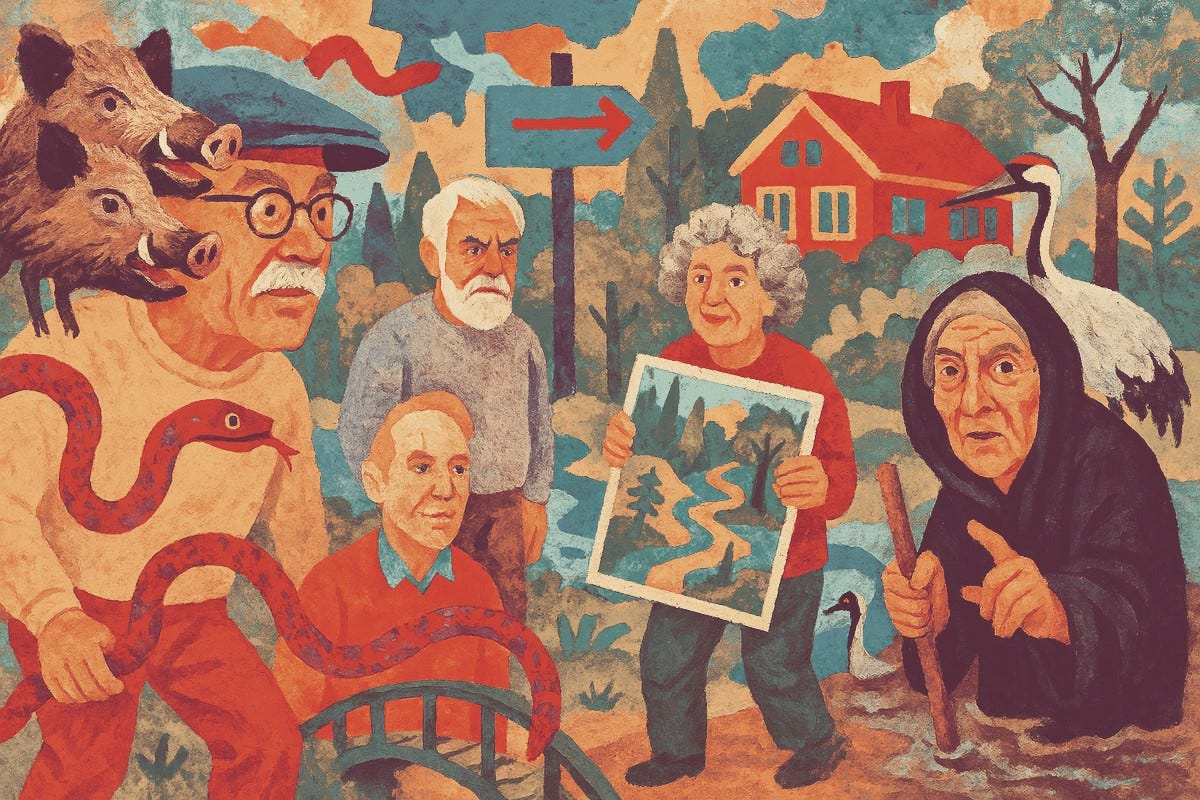
You met at Sverker’s place, in the orangery attached to his extended summer cottage on Malmvägen. He served cheese puffs spiced with chili and Ramlösa — as he apparently always did. After a short chat about how heat affects the growth of lichen, they started asking more pointed questions about how you might best contribute to the group’s future.
Sverker said:
“After the orienteering club’s initial push, we’ve pursued a rather expansive trail policy, you see. But these days we’re so decrepit it’s mostly just maintenance of the network. Walking the loops. Fixing the footbridges. Filling in potholes with gravel. A bit of brush-cutting now and then, to clear out the undergrowth.”
Marianne said:
“These days I can hardly walk more than a kilometer and a half, so mostly I paint signs and draw maps. And do some public education, of course. Did you know that some of these trails are remnants from when the charcoal burners used to take the shortest route between their kilns?”
Gun said:
“Truth be told, we’re well equipped for winter. With the right soil-packing, a trail can hold for a very long time — though I’m sure you know that already. And the wild boars do help out a bit, so they’re not all bad.”
Your mission became to scout possible extensions of Branting Trail, which wound its way from the architect’s villa, past the townhouses, the raspberry thicket, and the power line corridor, then skirted the bog the kids called Narnia, before abruptly ending in a dense patch of brush. That was as far as the Trail Group had gone, and it was now up to you to suggest a suitable continuation.
So it was that you found yourself wandering through the grove. You’d been instructed that while forest visibility was important, the trail should also pass through denser sections to add variety and a wilderness feel — which is how you ended up trudging straight through the thickest hazel underbrush.
Before long, you found yourself crossing Långvik Marsh, through wetlands and glacial potholes. The cranes took off in alarm as you came crashing out of the wilds. Then you turned around and walked the same way back. Then you bushwhacked through again.
By the afternoon, a path had truly begun to appear — the first shortcut between Narnia and the marsh, shaped by your steps, its discoverer. Here you were, Ingarö’s Magellan, you had time to think.
That evening, just as you were about to call it a day, a strange figure appeared by the oaks. She shuffled toward you, gripping a hefty staff in one hand. An elderly woman, easily over ninety, with something like cobweb yarn draped over her head.
She was now quite close, and she asked — more like declared — as if speaking over your head:
“So, they’ve got themselves a new recruit?”
You nodded and smiled. She went on, jabbing her staff toward Björnö:
“Poor soul, you had no idea what you were in for, did you? I’ll bet they started rambling about their ‘expansive trail policy,’ and then — purely by chance — suggested Branting Trail as a suitable entry-level project?”
You nodded.
“And so you ended up here, like all the other newcomers, smack in the middle of my trails. Right in the border conflict.”
You nodded again, mostly out of habit now. She gave a pitying smile, lowered her voice, and beckoned you with a crooked finger:
“Come a little closer, sweetheart. I need to tell you something important.”
You stepped cautiously forward and caught the scent of cigarette smoke wafting from the old woman — when suddenly, your feet refused to move. Boots and calves sank beneath the surface, and soon you couldn’t move at all. The mud crept up to your waist, your chest — and paralysed, you sank into the bog, into your undoing.
I hope that some of this has resonated with you,
✦ jorgenlowenfeldt.se ✧ bagatellerna.se ✦
The Bagatelles is a reader-supported publication. To receive new posts and support my work, consider becoming a free or paid subscriber.
When you do things in public, things happen that you could never have expected. You might say that surprises are, in principle, the only thing to be sure of. One such moment…