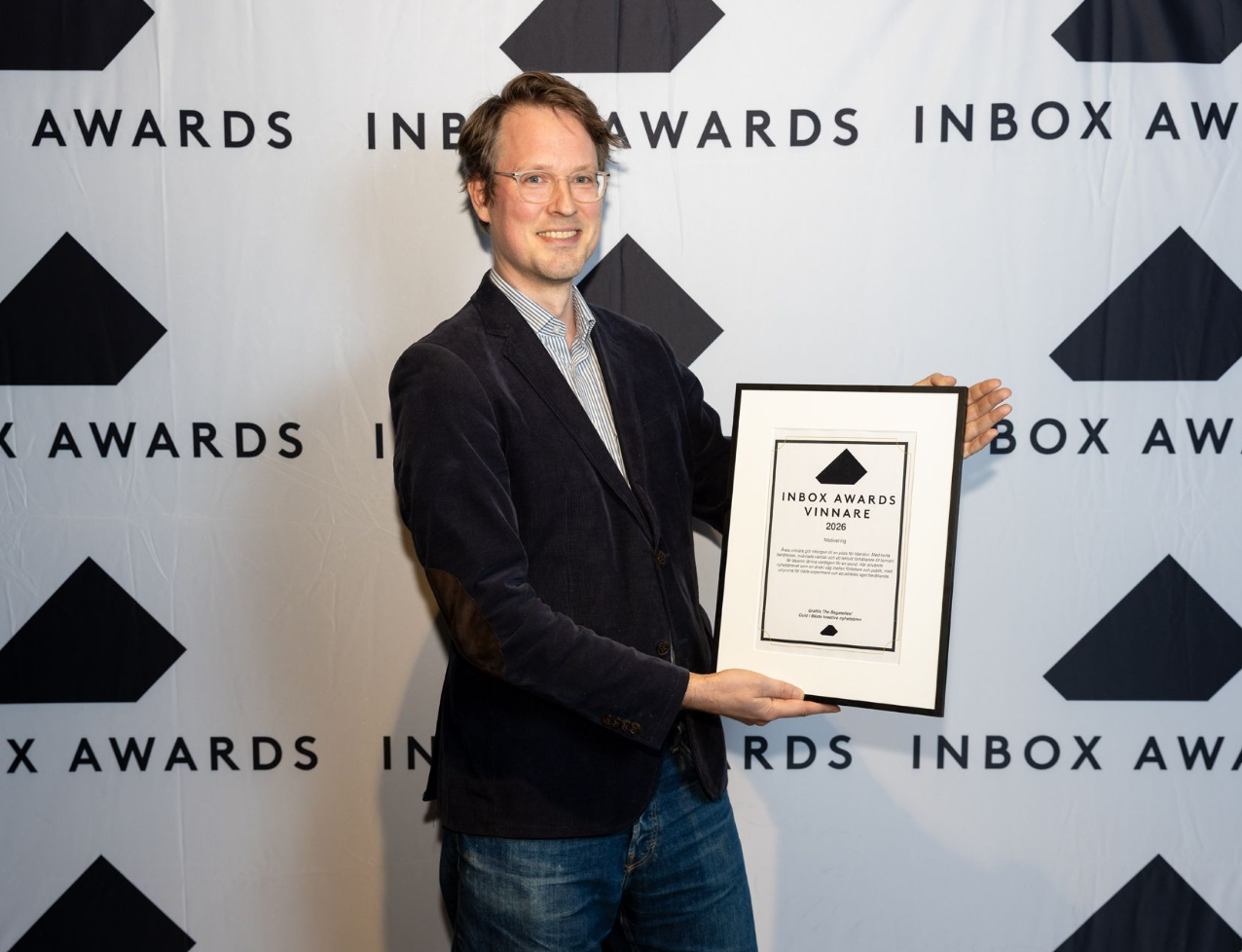
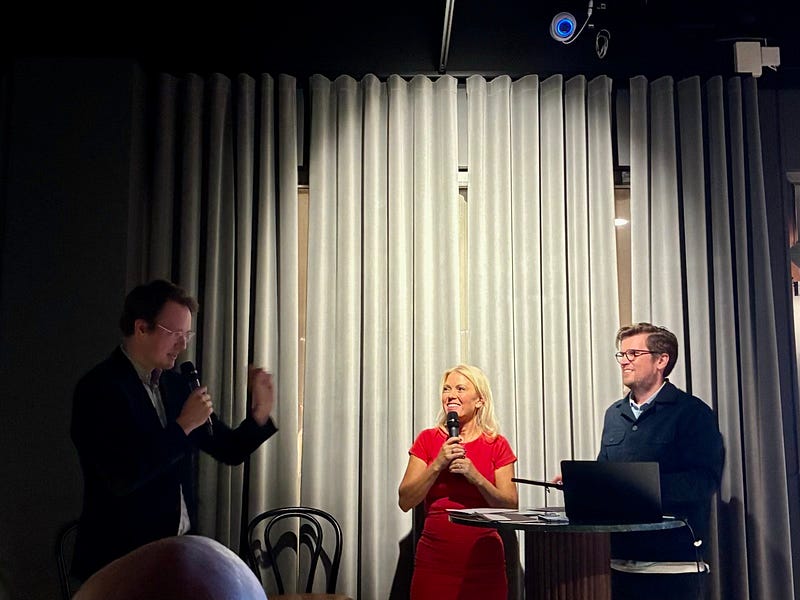
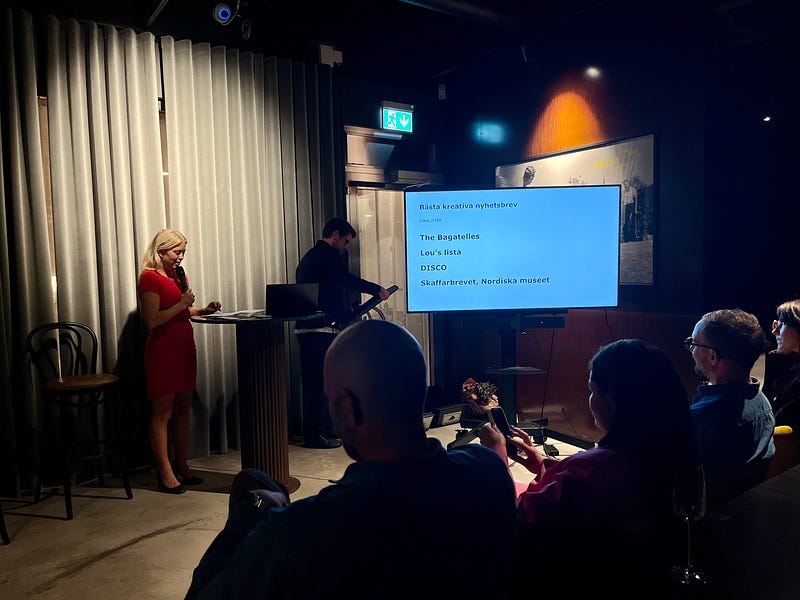
For months I have been searching for an opening to this essay. On walks and bus journeys, I have turned sentences over in my mind, only to discard them soon afterwards. One was about trying to work out what enough means, another about a tender telephone conversation with Björn. My third attempt began with the on-stage interview I had last week after winning the award for Creative Newsletter of the Year, in which I spoke about how writing and success are opposing forces.
They all felt contrived.
If a truly good opening had presented itself, I would have recognised it, just as I can immediately inhabit a beautifully written metaphor, be pierced by the harmonies of a choir or shiver at the sight of a perfectly struck football.
I know perfectly well why this has happened, and that is precisely what this essay will be about.
Glances over our shoulders
as we work
and over the shoulder of the shoulder of the shoulder
Everyone has a swarm of everyone
in the panopticon society
A kingdom for a corner
In the autumn of 2020, I decided to close all the doors and windows and draw the curtains. I had my reasons. It is a familiar scene in literature: the aesthete who, like Henry David Thoreau in Walden, leaves society in order to become one with the world.
There are not nearly as many accounts of what I then needed to do to achieve stillness: delete my social media accounts. On those platforms, I had helped keep the conversation going day and night. Not a single holiday had escaped the attention of my circle of acquaintances, or whatever you call that mixture of thousands of friends and strangers who formed the audience for my life, all of whom vanished in a few keystrokes.
The essayist Michel de Montaigne would have known all about it. He has occasionally been called the world’s first blogger, owing to his graphomaniacal urge to tell stories about his everyday life. As early as 1580, in Of Solitude, he presciently wrote that we must keep “a back shop all our own”: a room behind the shop where the demands of the outside world cannot enter and where we can keep ourselves company. Perhaps it was precisely because Montaigne was so intensely sociable and politically active that he was forced to recognise the need to withdraw as well.
Many creative people have expressed the same thing. Virginia Woolf emphasised the importance of having a room of one’s own and financial independence in order to write. Hannah Arendt distinguished between solitude and loneliness: in the former, we can keep ourselves company and conduct the inner conversation that thinking requires.
But what good is closing the door when all the windows are open? A more modern example is Jonathan Franzen, who removed his laptop’s wireless card, plugged its Ethernet port with a cable fixed in place with superglue, and then sawed off the protruding end. He described this in a profile in Time magazine in 2010.
Had Thoreau been alive today, he would probably have needed to do the same and delete all his social media accounts as well. For true stillness does not settle in until the digital chatter disappears, as I discovered in bed that autumn. The calm, initially psychological, became physical. A low, persistent stress vanished. My joints softened. I began conducting the inner conversations that thinking required. My thoughts were longer, quieter, like a strange echo coming from somewhere behind me. I had time to listen now that the fast, bleating, impulsive voice no longer occupied all the space.
Suddenly, a realisation: Everything I need to be happy is already within me.
The realisation took hold of my entire being, and I still carry it with me.
Unlike Thoreau, I had not moved a centimetre. I could still be reached by telephone or letter, and even by email. Yet it felt as though I had gone for a swim on Ganymede. The fact that everyone was still talking about their jobs on their platforms, campaigning for social causes or discussing Eurovision concerned me no more than a conversation over coffee at the tax office in Chittagong, or an astronaut’s dream aboard the International Space Station.
I had expected some sort of reaction. If ever a silence spoke volumes, surely it was this one? From megaphone to mute. Only after two weeks did an acquaintance email to say they could no longer find me on Instagram. A week later, another person got in touch with a similar question. After that, nobody mentioned it again. Nobody else in all the years since. My noise had simply been replaced by other people’s noise. They say that other people don’t think about you nearly as much as you imagine, and here was the proof.
It didn’t matter much, because I was busy living a different, more purposeful life, with people who had my phone number. I learnt to meditate, reached a deeper octave within myself, confronted fears, discovered Proust and read him undisturbed for hours, wrote poems and aphorisms and collected them in a small work I called The Book of Ashes, which until now I have kept to myself (as I wrote in it: announcing that you have withdrawn is not withdrawing). You will find extracts from it scattered throughout this essay.
It may sound paradoxical, but withdrawing expanded my social life. I started playing basketball, occasionally photographed my surroundings but shared the pictures with only one or two friends, and wrote short fiction every morning that I felt came closer to the soul (many of these pieces have become cornerstones of the online work we now know as The Bagatelles). I found a writing group, with whom I am sitting as I compose this text. Life went on, only without my having to tell anyone about it.
Or, as the philosopher John O’Donohue put it: “The great emergence of creativity is when the sound comes out of the silence.”
The whole sea is stormy but there’s always room for everyone
and come along it’ll be fun
you don’t want to be left out do you
It might be good for you further down the line
Then a reckoning rolls in with the horizon
fear of missing out when out is all there is and never in
One of the biggest mistakes you can make when trying to organise your understanding of the world is to start from yourself and assume that everyone functions as you do. An almost equally big mistake is to think that your experience is unique and that no other human being can understand you.
I would like to think that at least a few people will recognise themselves in what I am about to describe. Namely, that there are two systems within you, driven by entirely different motives and incentives. Perhaps you are someone like me, who prefers corners in restaurants? You enjoy spending time with other people, but need a great deal of solitude to recharge your batteries, because you are a vessel for impressions? You have a voice inside you that is loud and impatient and impulsive and, unless you are careful, almost always wins? And another that is quiet and patient and is usually pushed aside, even though you know it is right.
Unfortunately, these two sides, which we might call the inside and the outside, struggle to coexist. You can, of course, withdraw and let the slow side rule for a while when your willpower is strong, but then something happens. All it takes is the slightest hint of the fast, and you can feel it rapidly spreading through every part of you, like a drop of ink in a glass of water.
Living on the outside also means constantly provoking the world into action. It might mean visiting news websites in the hope that something has happened, mingling incessantly and regarding every idle second as a wasted one, messaging colleagues on Slack, or posting something on Substack Notes in the hope that someone will respond. So that you can reply. Entire days revolve around reactions to your actions. Apparently, it is possible to live an entire life in a reactive state. There is always another inbox you haven’t checked in the past hour.
What you may not know, however, is that my surprisingly peaceful experience of being disconnected, lying there in bed, has been given a scientific explanation. Leonard Reinecke, a professor of media psychology, calls it “online vigilance”. The internet affects us not only when we are actively using it, he argues, but long afterwards. Reinecke divides the process into three components, which you will recognise from the previous paragraph: 1) salience, when our thoughts continue to revolve around what is happening online, 2) reactibility, the readiness to respond immediately, and 3) monitoring, the impulse to return and check what has happened.
Other studies have shown that people who experienced higher levels of online vigilance also reported greater mental fatigue, while actual mobile phone use appeared to explain relatively little of the variation. And we haven’t even mentioned how damaging interruptions during writing have been shown to be for the quality of the text.
We can call what I am writing about in this essay the inside and the outside, or the slow and the fast, the loud voice and the quiet voice. However, no longer offline and online. To put it somewhat drastically: As long as you are online at some point, you are never offline.
I took a step back
the step took me back
I am me here
I am a rediscovery
Some time passed. I found myself spontaneously calling friends I hadn’t spoken to for ages, and some of them wanted to read my writing. These stories, which you know as bagatelles, I sent through Gmail, so that I wouldn’t have to keep track of reactions (although many called back to discuss what they had read). Most of the time, the stories simply disappeared into the tangled skein of cyberspace, and that was that. This was important, because I understood that the moment notifications or statistics were introduced into the arrangement, everything would be ruined. The fast would drive out the slow.
When I launched The Bagatelles on Substack in February 2025, I was therefore fully aware of what was at stake. I wanted to share my writing, find a new audience and a way to take control of my creativity without gatekeepers. After analysing the platform for a while, I concluded that reaching people would require me to remain active on Notes, Substack’s Twitter clone.
I set myself a target of reaching five hundred subscribers, then returning to the inside and letting the texts live lives of their own. There are now almost five thousand of us, and I still haven’t stopped. There does seem to be something about that particular number. The Substack writer Rachel Katz reached it two years ago and decided to put the brakes on hard, while observing: “So I have people reading my work now, but I’m not doing the work that I originally wanted people to read.”
Living on the outside, as I have once again done to some extent during these twenty months as a suddenly global internet writer, brings opportunities. You are easier to reach, and as you constantly send out new signals that are picked up by readers on every continent and carried further into their own circles, unexpected requests can find their way into your inbox. Such as interviewing Nobel laureates, receiving prestigious job offers, being invited to the August Prize ceremony, or being asked to write essays for foreign magazines. All real examples from the past few months.
The outside offers real rewards, real results and real stimulation. Without it, my life would have looked very different. I don’t think I would have had my children, and almost certainly not my job. But here is the crux of this essay: the person who wrote the most appreciated pieces was in a different state from the person who published them, and with every interaction it becomes harder to produce what readers came here for in the first place (yes, exactly what Rachel Katz just said).
My writing has clearly been affected. Most of it turns out all right, sometimes even well. Yet it never feels quite as true as it did when I was playing in the lower octaves.
Before I saw the rapids as rapids I tried to capture them
and capture them
all the time capture them
and they broke free
all the time they broke free
Does it have to be one or the other? I’m afraid it does. The computer scientist and deep work evangelist Cal Newport calls this state the hyperactive hive mind, the phenomenon in which we keep one another busy with a constant sense of being slightly productive at every moment. Few great literary works have been written in that state, but many have probably been pitched in it. Many followings have grown. Networking has been carried out successfully. Things that also matter in our time.
On the occasions when I have taken a break from all this over the past year and found peace again, I have eventually been astonished when opening the app. How could I have become addicted to that? The feed seemed to consist of nothing but strangers talking over one another. Much the same feeling I still get whenever I see someone using any of the other social media platforms, whose development reminds me of the story of the boiling frog. Can’t you see what they’re doing to you?
Every time I manage to regain my composure, the outside eventually returns. Something happens, I need to act. Just when I thought I was out, they pull me back in, and suddenly I can barely remember the logic of the inside, while the outside intoxicates me into an ever deeper numbness. And like any intoxication, it wears off, so you need more. Besides, it does little to satiate you.
On my way to a book launch (sadly not my own), I write, metacognitively and somewhat despondently, in the Notes app on my phone: “And what has happened has happened and has become the new normal. Things to take for granted because I’ve already experienced them.” Just before this, I have made a list of the autumn’s activities to work out why my sleep has been suffering. Then I ask ChatGPT what a network is good for. What success is good for. Because you always end up back at the same point. “A network is unrealised scope for action,” the AI replies.
I want to answer: “Isn’t being present for yourself and those closest to you, in the one life you have, a fundamental prerequisite for success?”
The nails come loose
the walls fall
I am the beads of mercury racing endlessly in every direction
I am free I am desolate
In Transcription, Ben Lerner describes how the narrator accidentally drops his iPhone into a hotel sink. He is later out walking, still using his mobile in his mind, like a phantom limb: taking photographs, FaceTiming his daughter, searching for “song bird life expectancy”. When he can no longer actually do any of this, he begins daydreaming about previous visits to the place, something he suggests his phone use would otherwise have prevented. Then he runs into an old friend whose name he has forgotten. He enters his number into her phone, whereupon she sends him a text so that he will have it “when he rejoined the world”.
Clearly, I’m not the only one who feels this way. So, what can we do? My conclusion is that those of us driven by both depth and curiosity need to find systems for choosing between them, rather like the way Thoreau went into the village every other day to hear the gossip. In other words, to regulate our participation. Or, as I wrote in my own list of notes to myself: Sometimes you need to live in a campaign. But you cannot always live in a campaign.
And there is evidence for this. The psychology researchers Kostadin Kushlev and Elizabeth Dunn had 124 people spend one week checking their email without restrictions and another week limiting themselves to three checks a day. During the restricted week, participants reported significantly lower daily stress, even though they rarely managed to stick to the limit (the average was 4.7 checks). I like to imagine that they also read more books, had deeper conversations with those closest to them and, if they wrote, wrote better, and came closer to the quiet voice, the one that is actually right.
Once upon a time, I depended on the internet as a place, a computer where I connected and disconnected. Then came Wi-Fi, and I started reading the New York Times at the kitchen table in my Stockholm suburb and thought it was wonderful. Then the internet became airborne everywhere and things got out of hand. The journalist Nicholas Carr warned us as early as 2008 (I felt it too, Nicholas). Social media and smartphones turned inattention into a widespread affliction, and it seems that AI agents have only accelerated the development.
We all need to regulate our use of intermittently reinforced feeds designed to make us addicted. To stop the loop of online vigilance.
1) salience, 2) reactibility, 3) monitoring. And repeat.
To summarise, and to unfold the paradox further. Thanks in part to my campaigning, I have reached almost five thousand subscribers in 116 countries, and that popularity has surely contributed to The Bagatelles winning an award. It is an important recognition and I am very proud. The fast state of campaigning has also meant that I have managed to produce neither a sufficiently good opening nor a sufficiently good ending to this piece. As I tried to explain at the awards ceremony in Stockholm that Thursday evening:
“It was during the years of isolation that my best writing came into being. What I want now is to find my way back to that feeling.”
I started The Bagatelles so I could do my own thing, without worrying about pleasing people who really didn’t care.
Tonight, 20 months later, the newsletter was named Best Creative Newsletter of the Year at the Inbox Awards in Stockholm (not something I expected when I started, I can tell you that).
On stage, I was asked what the best thin…
Now begins the phase when it isn’t over.