Short story 52 min · Password required
The Yes Man and the Invader
Already as I receive the email, I get a sense that something is off. The signature is set in an italic, hard-to-read typeface, and the sender uses a language I find overly…

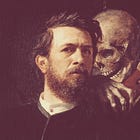
The same day I turned 42, I saw a dead person for the first time. She was wheeled out on a stretcher right in front of me on the pavement in Trieste, escorted by paramedics who, weary of it all, had forgotten to cover her face. As if death had become such a part of their everyday that, after countless trips to the morgue, they had come to treat it as the commonplace thing it is. That’s how I came to see her, the white-haired woman with her mouth half-open and eyes staring blankly. She appeared neither in pain nor at peace, but caught in some in-between. It took me a few seconds to realise she wasn’t blinking. I looked up at the ambulance driver, who seemed to be thinking about his dinner plans, then back at that rigid face, frozen in its final expression: it was time. That all the school leavers’ songs, tears, romances, diary scribbles and dance moves would end here, in that empty gaze. Life had left the body and gone where life now goes. She knew that better than I did.
Earlier that morning, I had woken up with the opposite feeling. That I was turning 42, after all. I hadn’t expected anything else, but I hadn’t exactly counted on it either. Then I was celebrated in our Airbnb room with frescoes on the ceiling, and we joked about the meaning of life, since The Hitchhiker’s Guide to the Galaxy claims it to be 42. I once went to a party with that theme, and the host is now 49, and apparently it just keeps going like this until one, like the woman on the stretcher, sees something that will be the last thing. A something that was neither frightening nor soothing.
As my own elixir dripped, we continued our walk, farther away from the woman, the stretcher and the ambulance, towards the bus station and our day trip to Slovenia.
They say architecture is frozen music, and Ljubljana unfolded before us like a composition. The miniature city had been meticulously sculpted under the guidance of architect Jože Plečnik, to such a degree that it felt risk-free to sleep on its park benches, as if living in a doll’s house. My companion and I delighted in the cosiness of the drizzle and gave in to becoming part of the composition, sharing space with every bridge, bench and banister. Now and then the woman’s stiffened face would flash before my inner eye, but the absorption that travel inevitably brings, with its open mind greedily devouring impressions without sorting the interesting from the uninteresting, always took over. And by the time we returned to Trieste half a day later, my first encounter with death had sunk deep into the pile of memories, which jostled one another in disarray, waiting to be sorted by sleep.
It wasn’t until we passed the pavement and the doorway again, our cloth bags now more heavily laden, that I recalled what we had been forced to witness, thanks to the sacrilegious negligence of the ambulance crew. I looked at the entryphone, then looked away and back again. There, inside the entrance, she stood. Alive. Blinking and breathing, with a few leaflets tucked into the crook of her arm. It was a miracle. I wouldn’t have believed it if I hadn’t seen her myself. My companion seemed to think I was playing a wildly inappropriate joke. No one else saw anything but air in there. And yet she was there. No doubt about it. Definitely the same face that had been lifelessly wheeled towards the ambulance just a few hours earlier. Then a pale husk, now rosy-cheeked and ready, and not the slightest bit interested in me.
The others carried on walking. Apparently there was some urgency to find a toilet. Dutifully, though reluctantly, I followed the group, returned to the room, put my phone on charge and lay down on the bed. Silly thoughts swirled through me. Perhaps she really was dead, but visible only to birthday children? Perhaps I’d been seeing dead people all day? Maybe it was like in The Sixth Sense, where the dead don’t know they’re dead, and they don’t see each other? Then again, maybe not.
The rest of the evening proceeded as planned, with dinner at a slightly posher restaurant, where we were placed far from the windows because they didn’t want to display tourists. Almost the whole time, I expected the woman to reappear, like a jump scare in a mirror or a spectre falling from nowhere. The only surprise turned out to be the bill, which had been bloated with all manner of surcharges the staff had apparently warned about in fine print at the back of the menu. Since I had to pay for the entire group, meaning fourfold torment, I returned to the room mildly irritated, not even noticing the cooler winds skimming over my scalp.
It wasn’t until I was brushing my teeth that I realised I had only an hour left of being the birthday child. If the theory was right, I had to act in order to close the story. By tomorrow, she would be gone, along with all the other dead. Ridiculous thoughts, perhaps, but did I really have anything to lose? She was only a few minutes away. It wouldn’t take long.
I said I was going out for a smoke, and no one paid any attention to it, since I’d bought a bundle of fat cigars in Slovenia. But I just headed out, and on, to construct a final meeting from the first. With the end, whatever it was. Nothingness had been a background hum throughout all forty-two years, but always in disguise: as anxiety about losing one’s teeth or adverts for face cream. Perhaps it wasn’t so final after all? Perhaps the religious madmen were right. Life was just one phase, death another.
The doorway was empty. What had I really expected? The stream of cars and Vespas was dense outside, roaring like a cacophony of motorism. I could never imagine this city going electric, as if it would simply become deaf. But then a young man came out with a few pizza boxes. I held the door for him and then slipped into the building. The names in the stairwell meant nothing to me. Only a few minutes left until midnight. I didn’t have time to hesitate, so I decided she lived at the very top.
With determined steps I conquered the stairs. On the top floor there was only one door, and it was ajar, as if I had been expected. The ceilings were high enough for a game of basketball. Persian rugs covered the floors. Along the walls, marble statuettes, plaster sculptures and baroque paintings shared space, their flaking paint hinting at inheritance over many generations. Breathless, both exhausted and thrilled, I stepped into the salon, where the woman was seated in a mahogany armchair, opposite an older man. They sat perfectly still, almost like museum guards, set there to sit and nothing more.
Sorry to intrude, I mumbled out of habit. The man, looking concerned, asked:
Who are you talking to?
I recounted the story of how I had ended up there. The stretcher, the birthday, even the urban planning in Ljubljana, because by that point I was properly dazed and couldn’t distinguish the relevant from the irrelevant. For some reason the man’s eyes filled with tears, and he explained, as calmly as he could, that something dreadful had happened earlier that same morning, and that his wife was no longer alive. They had been together when it happened, he stammered through sobs. A gas leak. It could just as well have struck them at 42 as at 84, he said, and added that perhaps he ought to feel grateful it happened so late in their shared life. But that was easier said than felt. Death was death, so to speak.
I’m sorry for your loss, I said. The woman turned to me, with a strangely amused smile:
You’re a funny one. Who are you talking to?
Already as I receive the email, I get a sense that something is off. The signature is set in an italic, hard-to-read typeface, and the sender uses a language I find overly…
When you do things in public, things happen that you could never have expected. You might say that surprises are, in principle, the only thing to be sure of. One such moment…